Why did the First World War start?

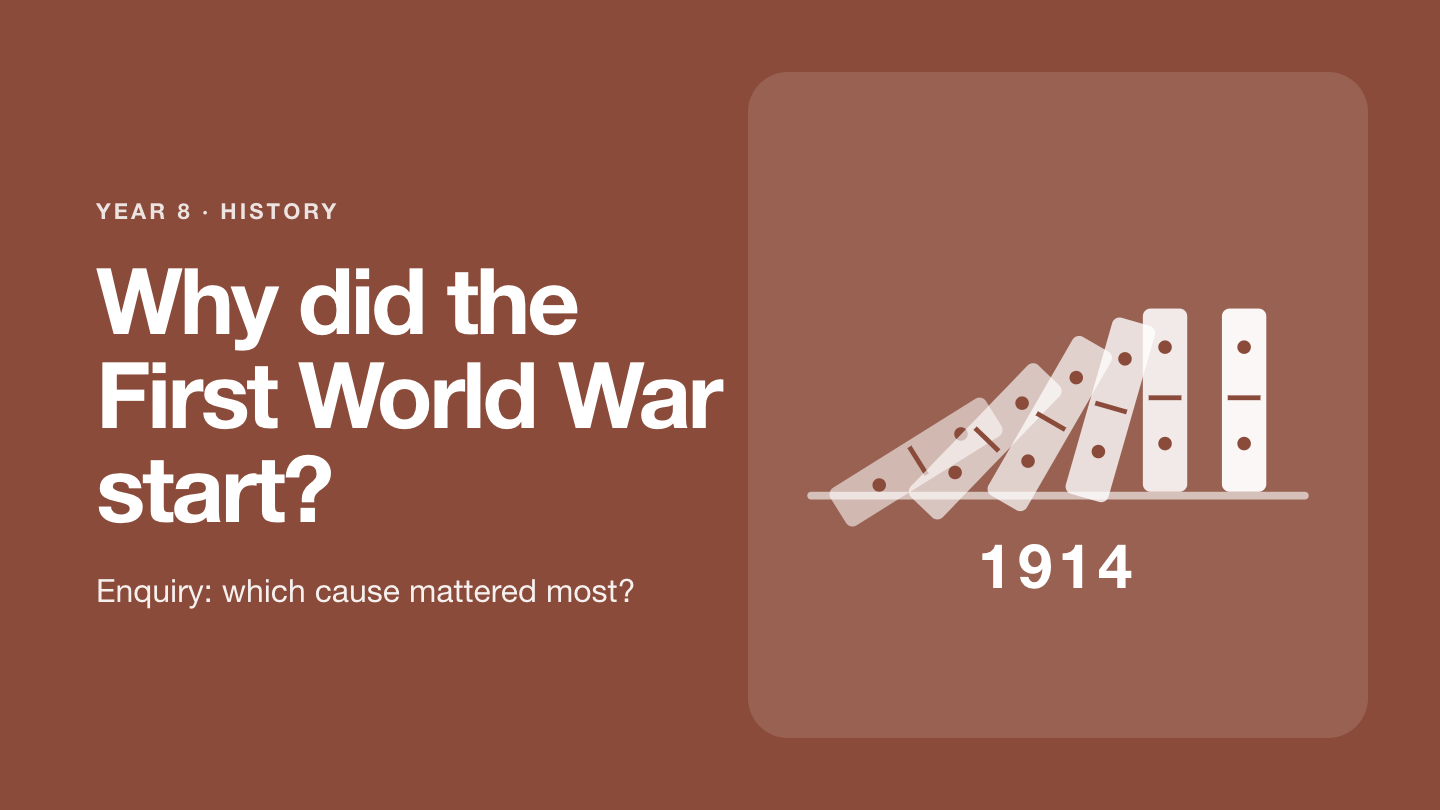
  1. Slide 1, title: Why did the First World War start? Year 8 history. Enquiry: which cause mattered most? A row of falling dominoes above the year 1914.
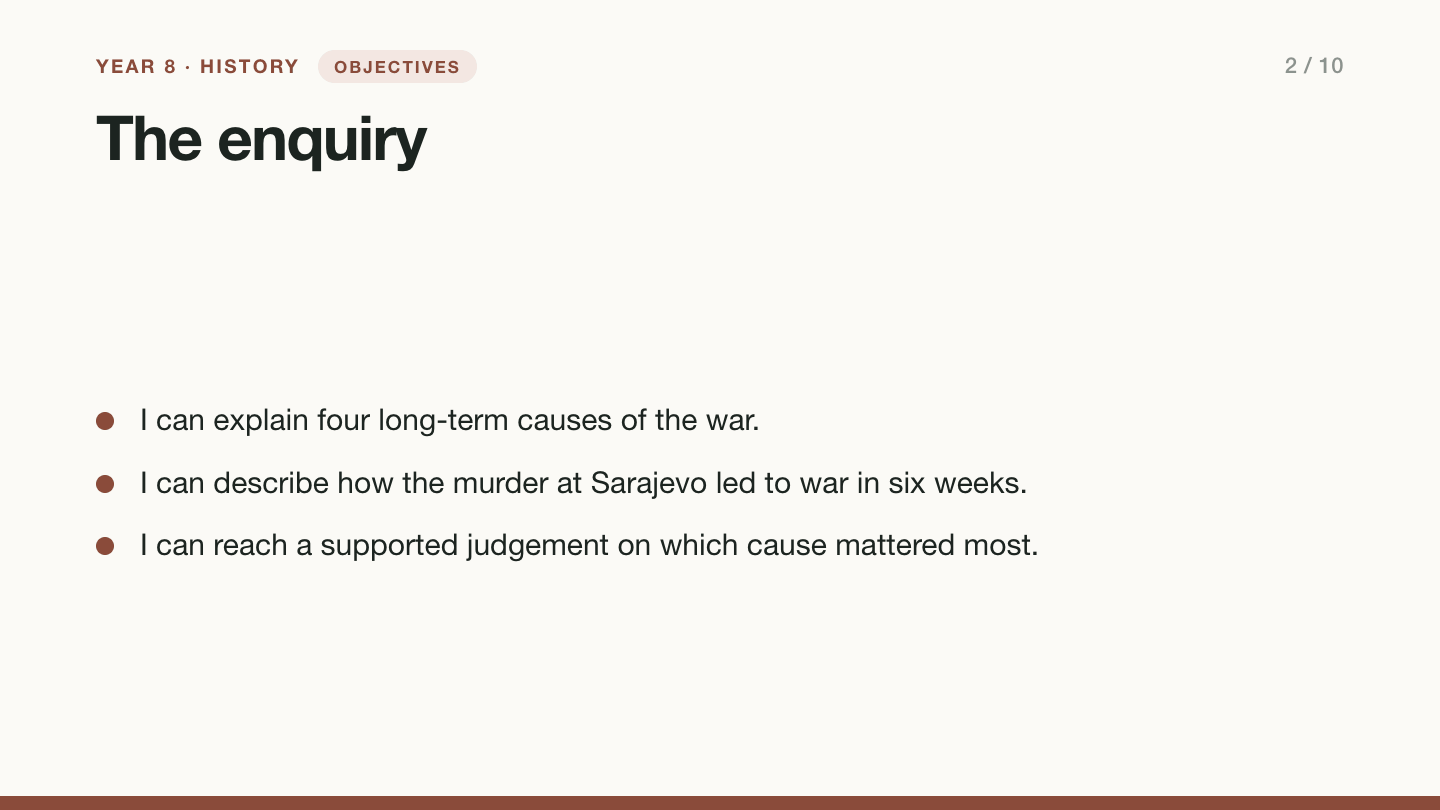
  2. Slide 2, objectives: The enquiry. I can explain four long-term causes of the war. I can describe how the murder at Sarajevo led to war in six weeks. I can reach a supported judgement on which cause mattered most.
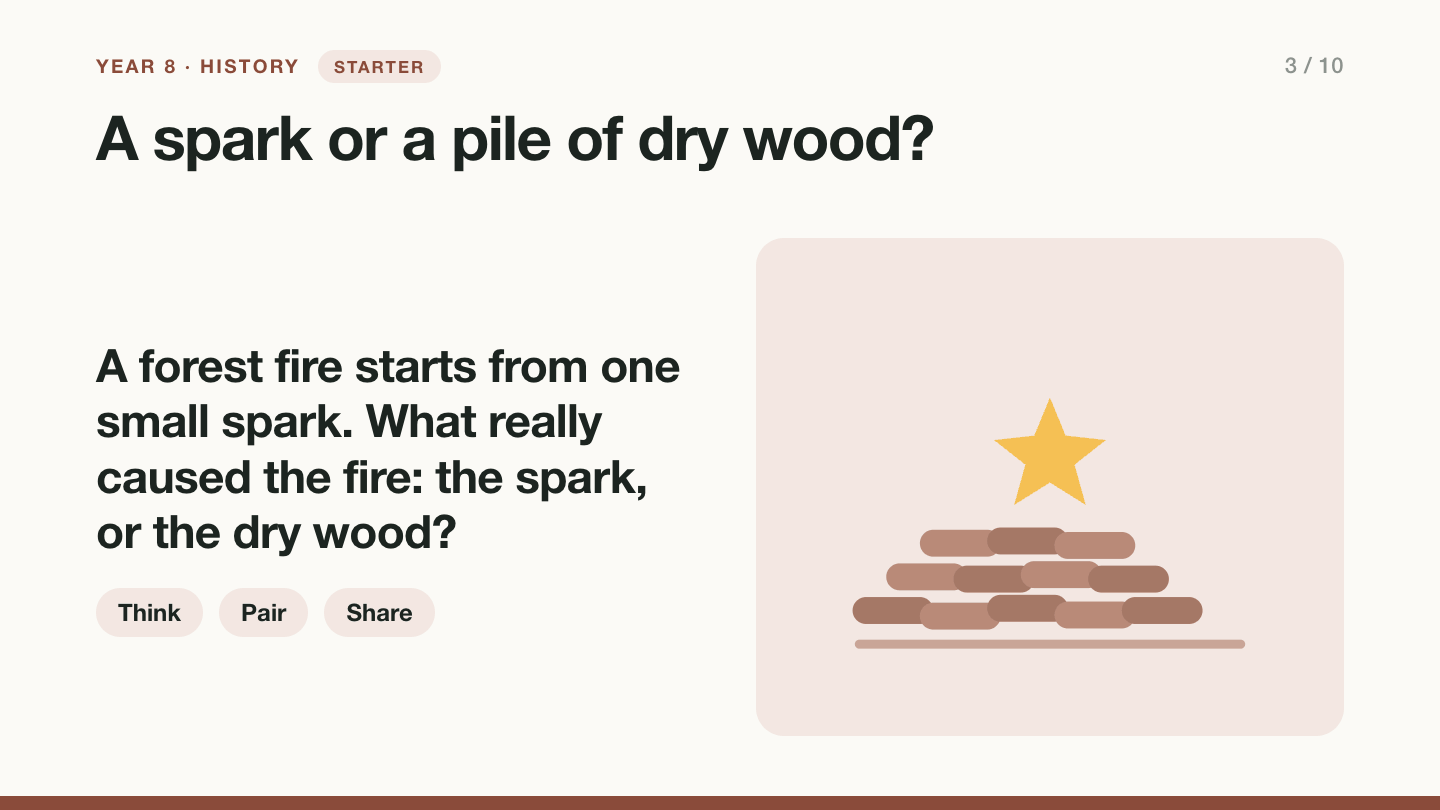
  3. Slide 3, starter: A spark or a pile of dry wood? A forest fire starts from one small spark. What really caused the fire: the spark, or the dry wood? Think, pair, share. A spark above a stack of logs.
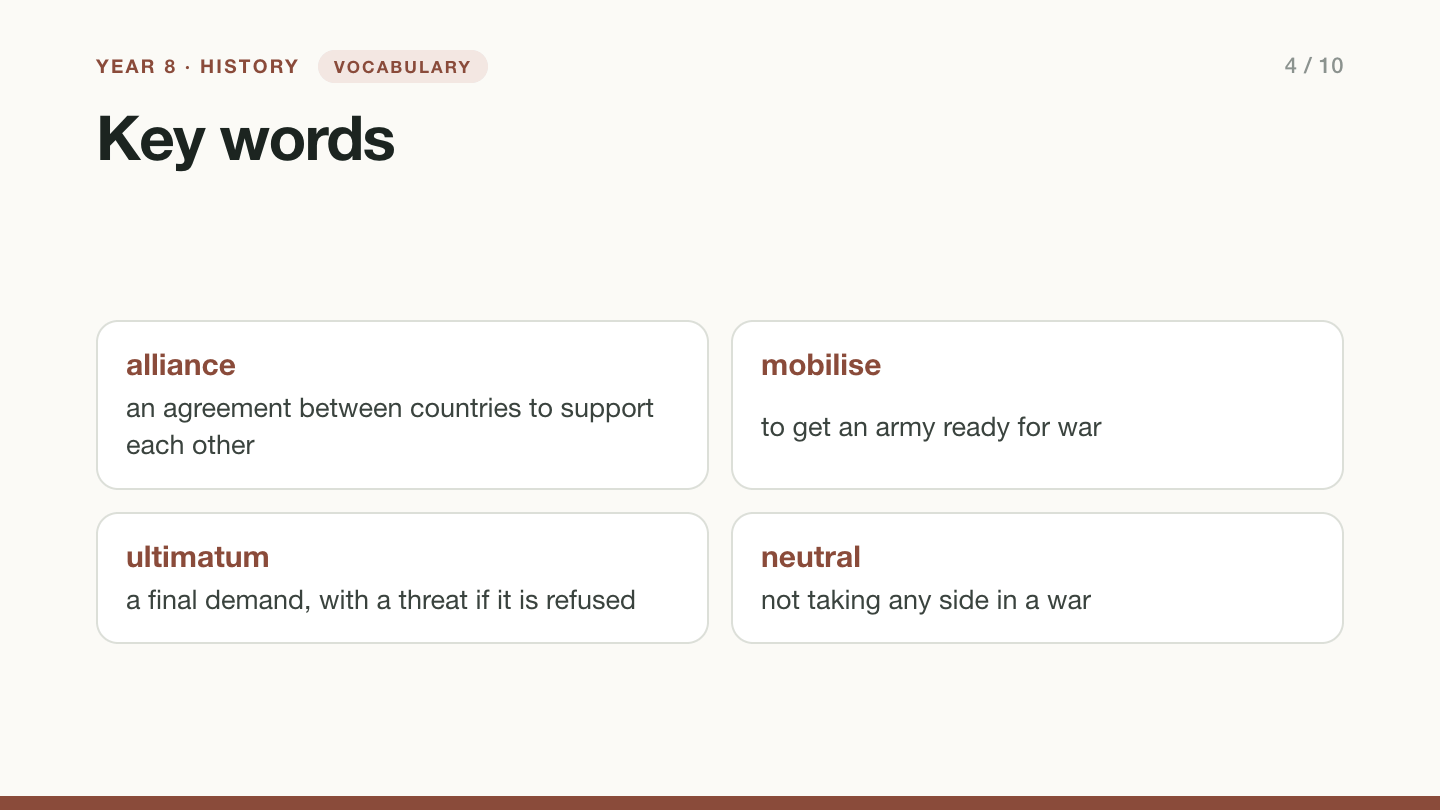
  4. Slide 4, vocabulary: Key words. Alliance: an agreement between countries to support each other. Mobilise: to get an army ready for war. Ultimatum: a final demand, with a threat if it is refused. Neutral: not taking any side in a war.
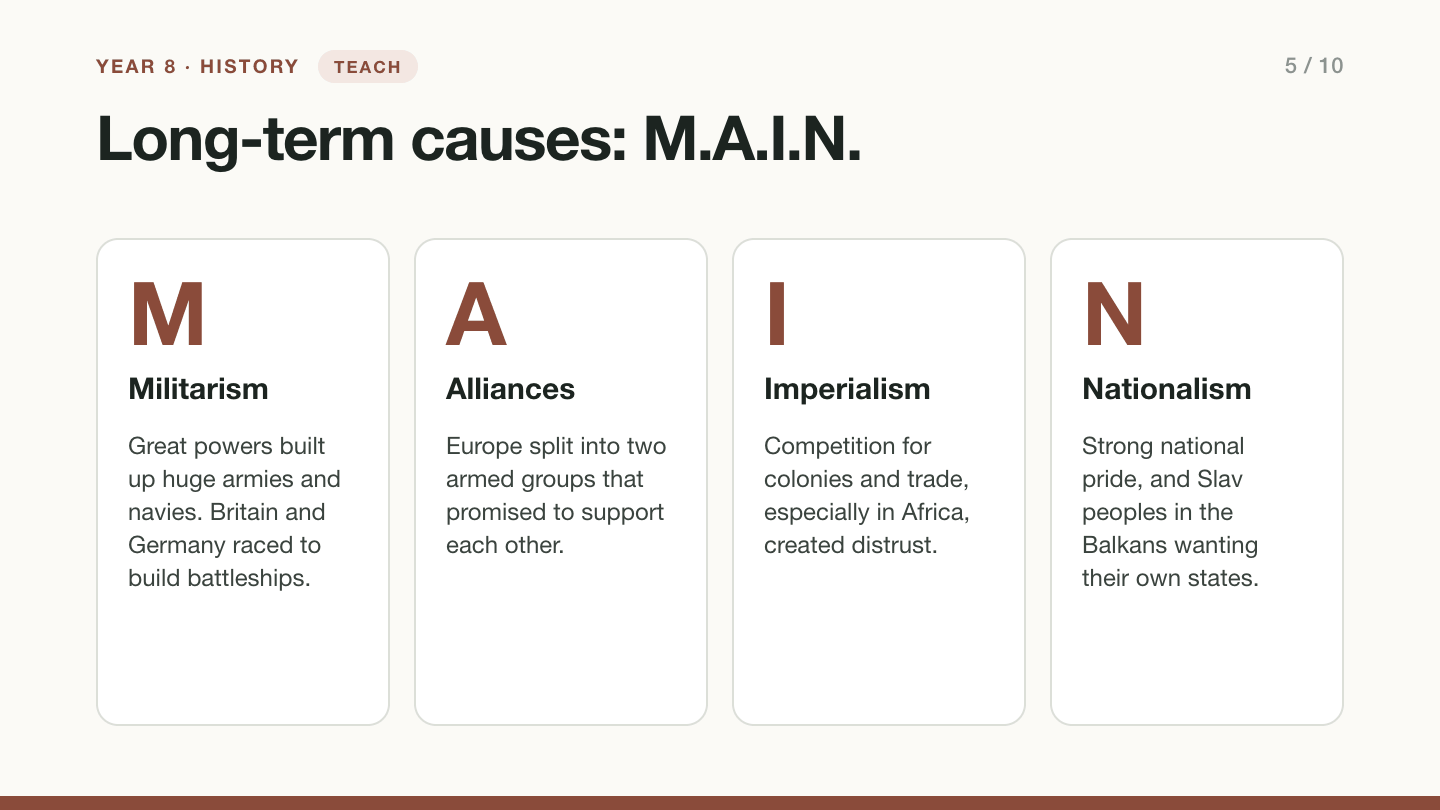
  5. Slide 5: Long-term causes, M.A.I.N. Militarism: great powers built up huge armies and navies, and Britain and Germany raced to build battleships. Alliances: Europe split into two armed groups. Imperialism: competition for colonies and trade created distrust. Nationalism: strong national pride, and Slav peoples in the Balkans wanting their own states.
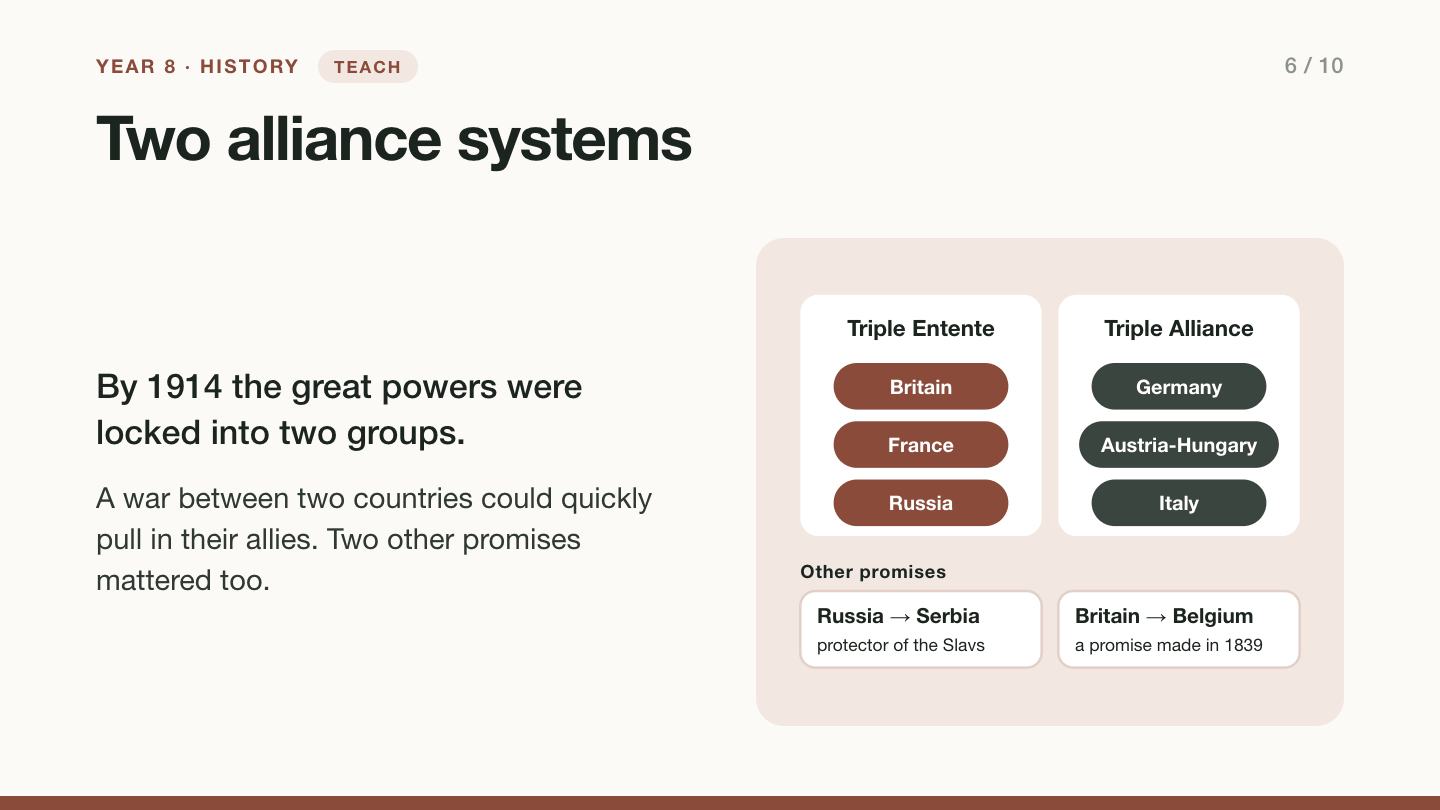
  6. Slide 6: Two alliance systems. The Triple Entente of Britain, France and Russia, and the Triple Alliance of Germany, Austria-Hungary and Italy. Two other promises: Russia saw itself as Serbia’s protector, and Britain had promised in 1839 to protect Belgium.
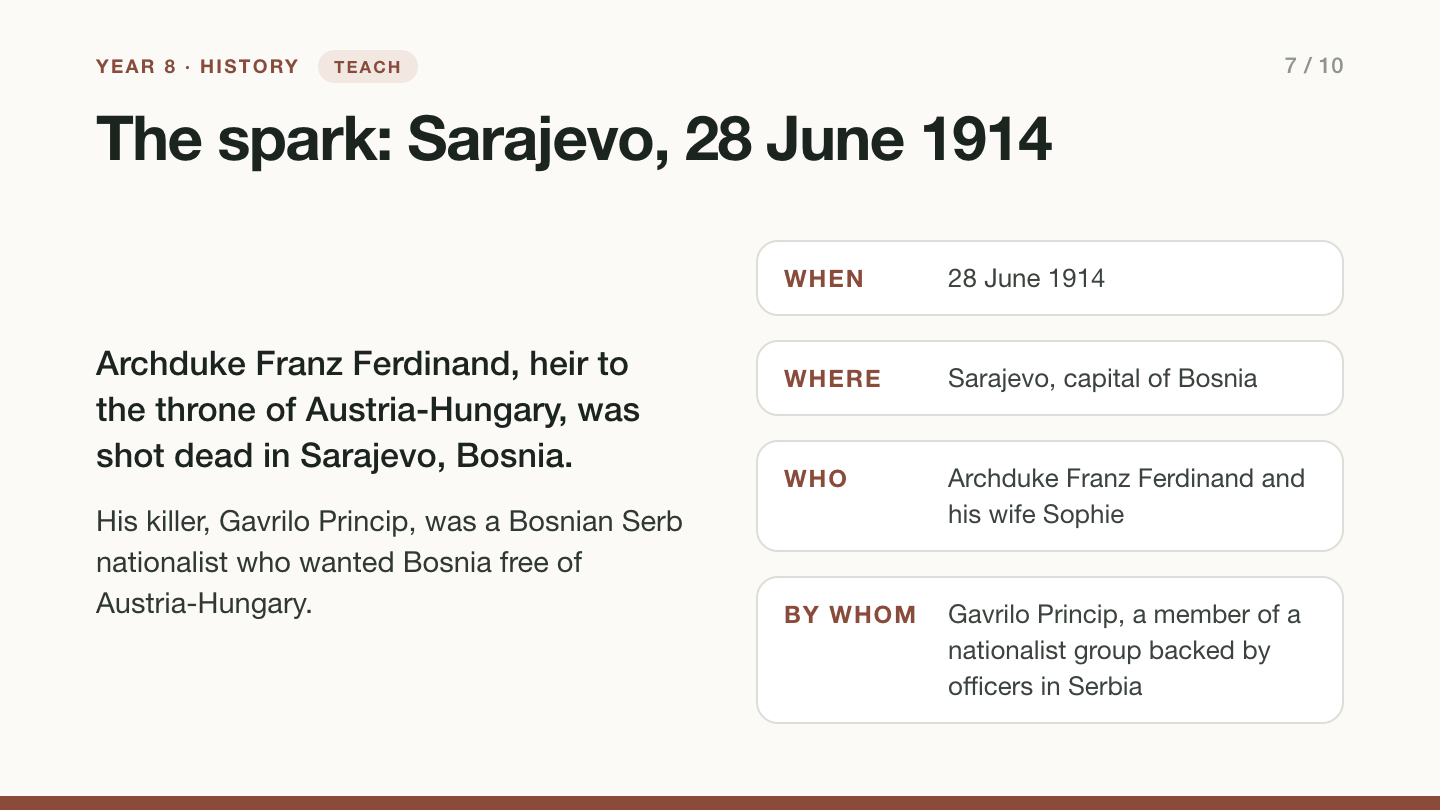
  7. Slide 7: The spark, Sarajevo, 28 June 1914. Archduke Franz Ferdinand, heir to the throne of Austria-Hungary, and his wife Sophie were shot dead in Sarajevo, Bosnia, by Gavrilo Princip, a Bosnian Serb nationalist who wanted Bosnia free of Austria-Hungary.
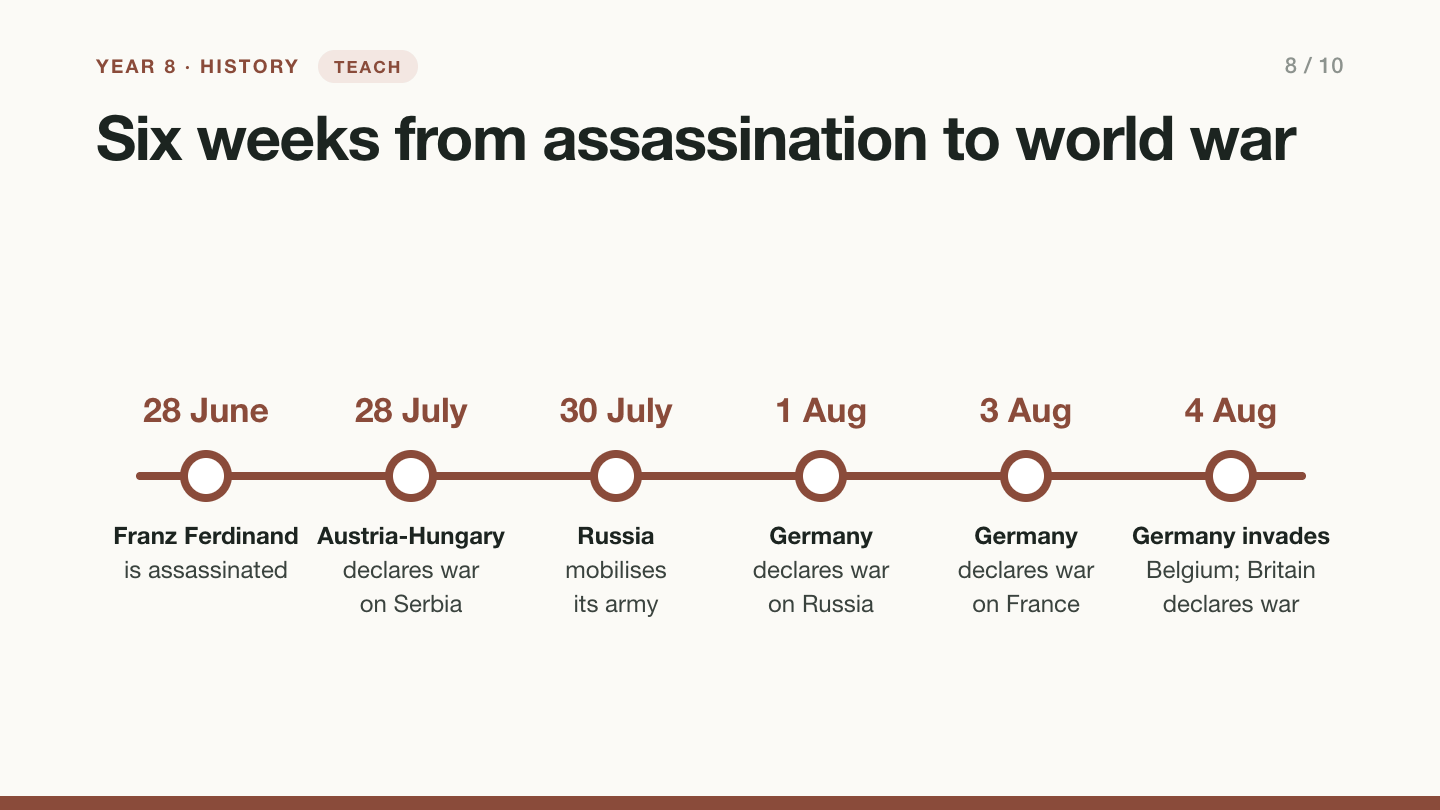
  8. Slide 8: Six weeks from assassination to world war. A timeline: 28 June, Franz Ferdinand is assassinated; 28 July, Austria-Hungary declares war on Serbia; 30 July, Russia mobilises its army; 1 August, Germany declares war on Russia; 3 August, Germany declares war on France; 4 August, Germany invades Belgium and Britain declares war.
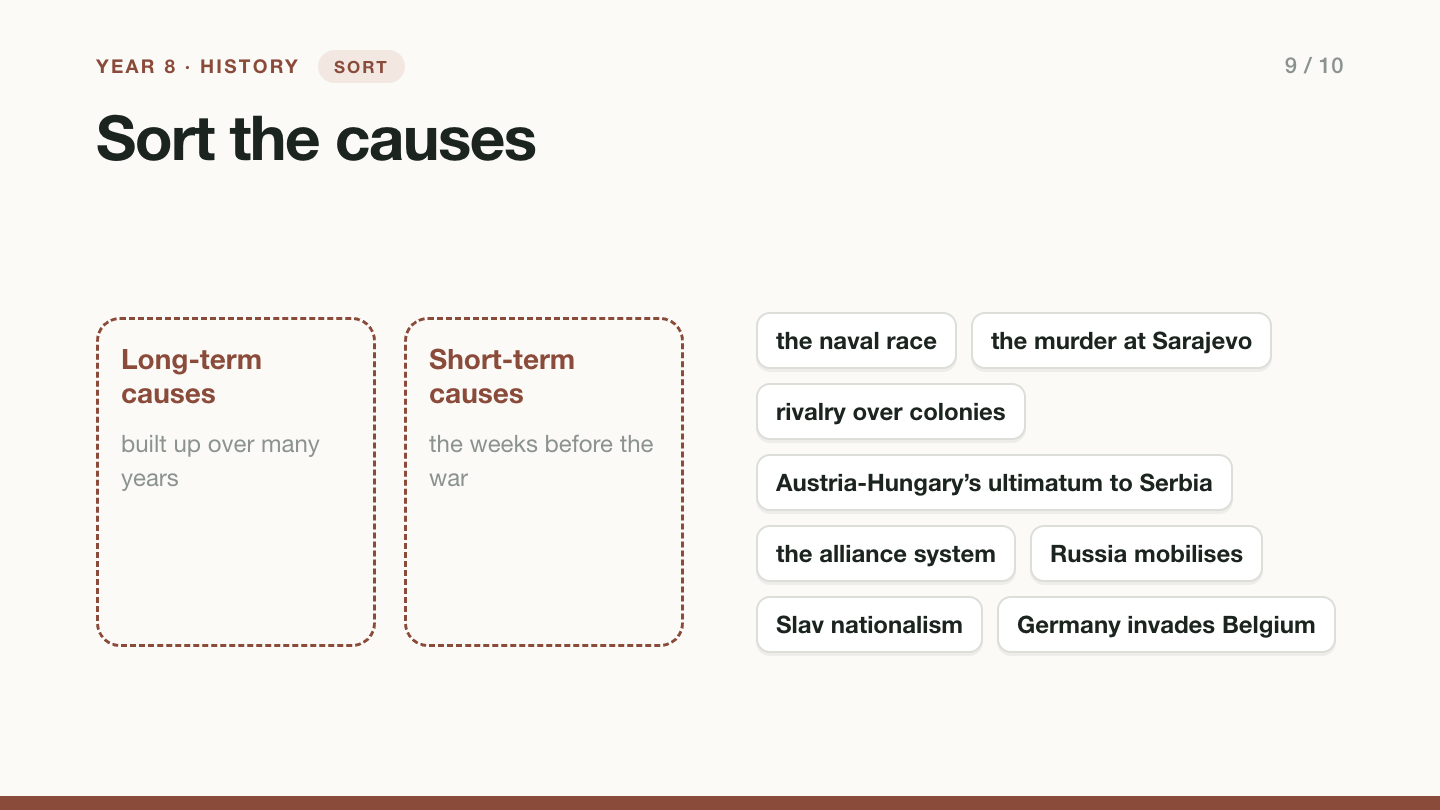
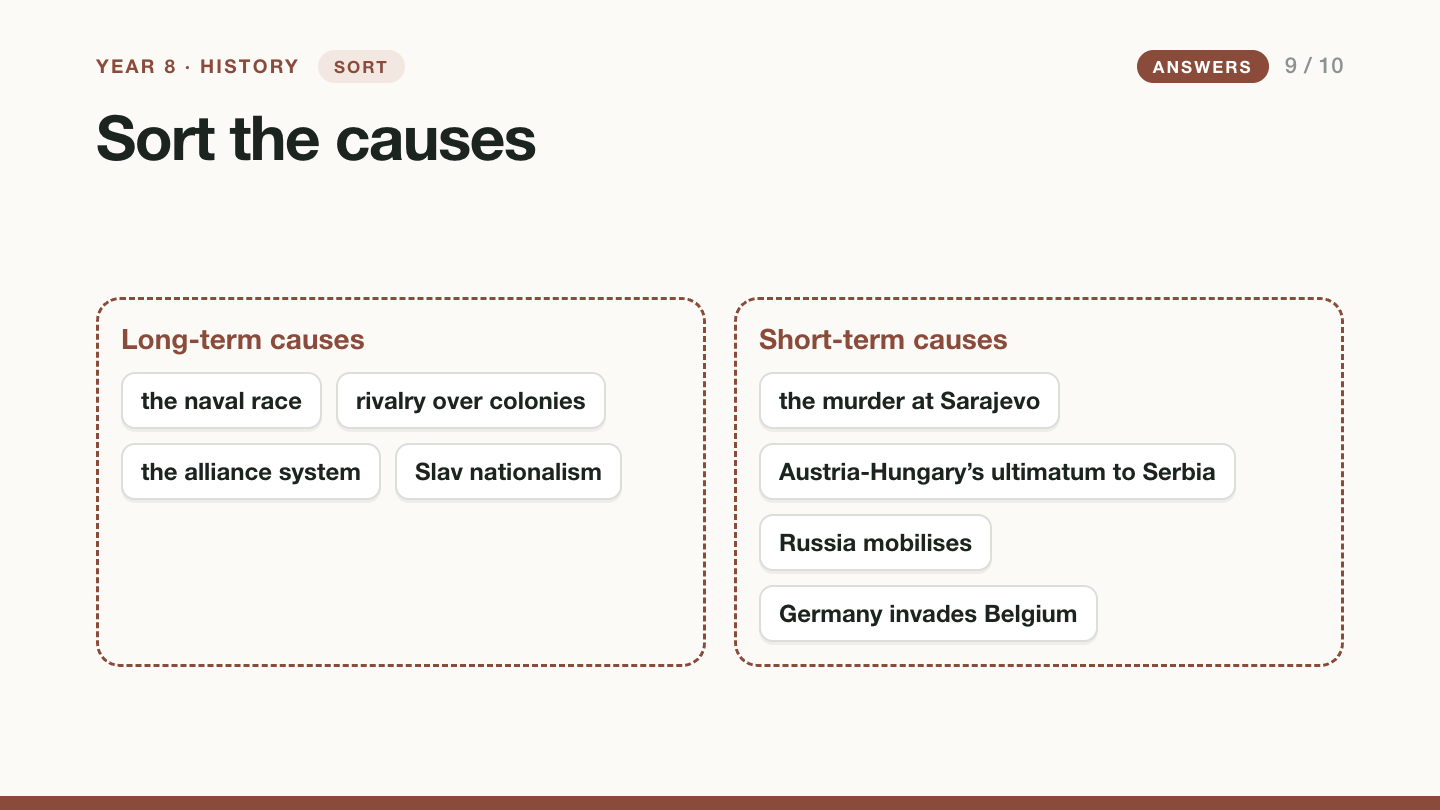
  9. Slide 9, sort: Sort the causes into long-term causes, built up over many years, and short-term causes, in the weeks before the war. Cards: the naval race, the murder at Sarajevo, rivalry over colonies, Austria-Hungary’s ultimatum to Serbia, the alliance system, Russia mobilises, Slav nationalism, Germany invades Belgium.Slide 9 with answers: long-term causes are the naval race, rivalry over colonies, the alliance system and Slav nationalism; short-term causes are the murder at Sarajevo, Austria-Hungary’s ultimatum to Serbia, Russia mobilising and Germany invading Belgium.
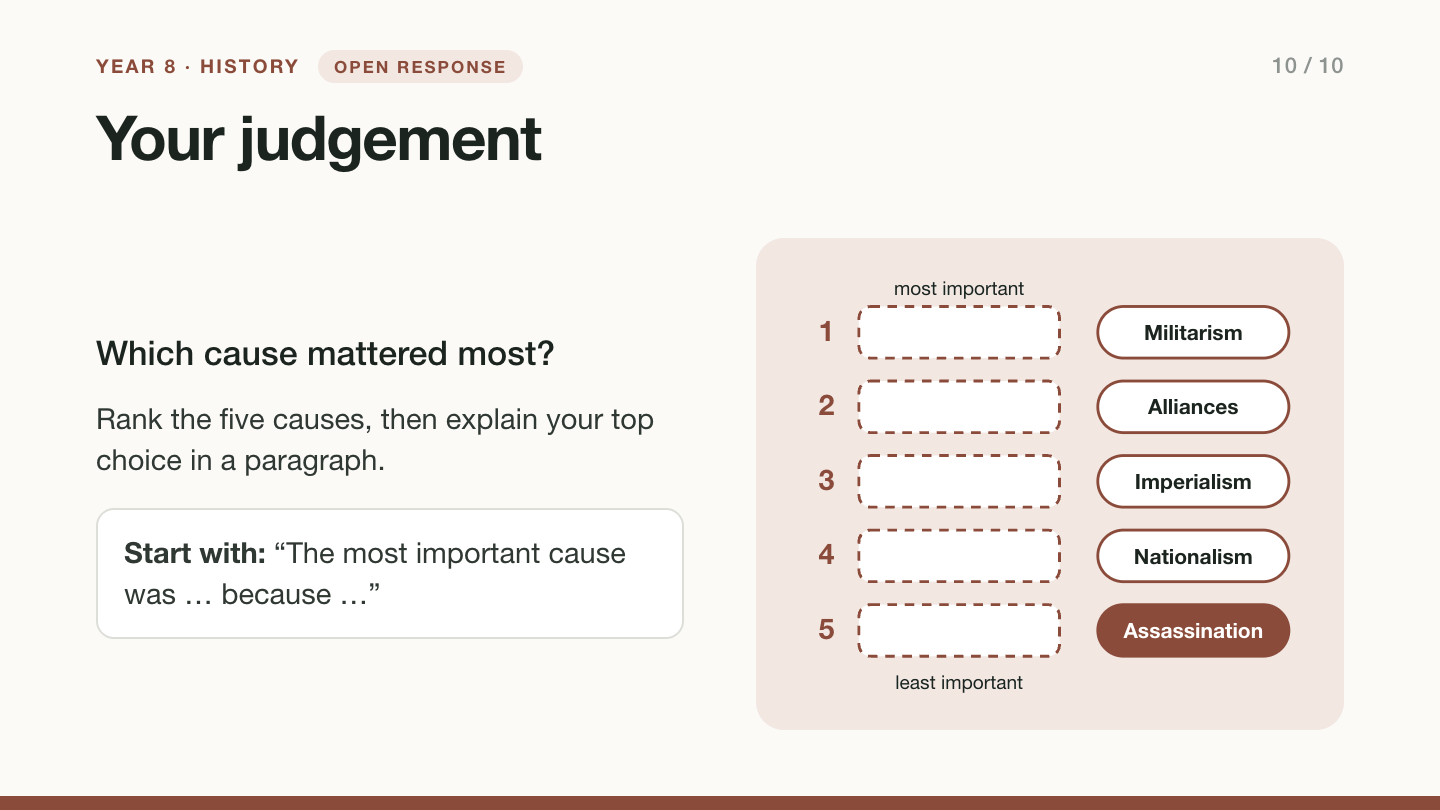
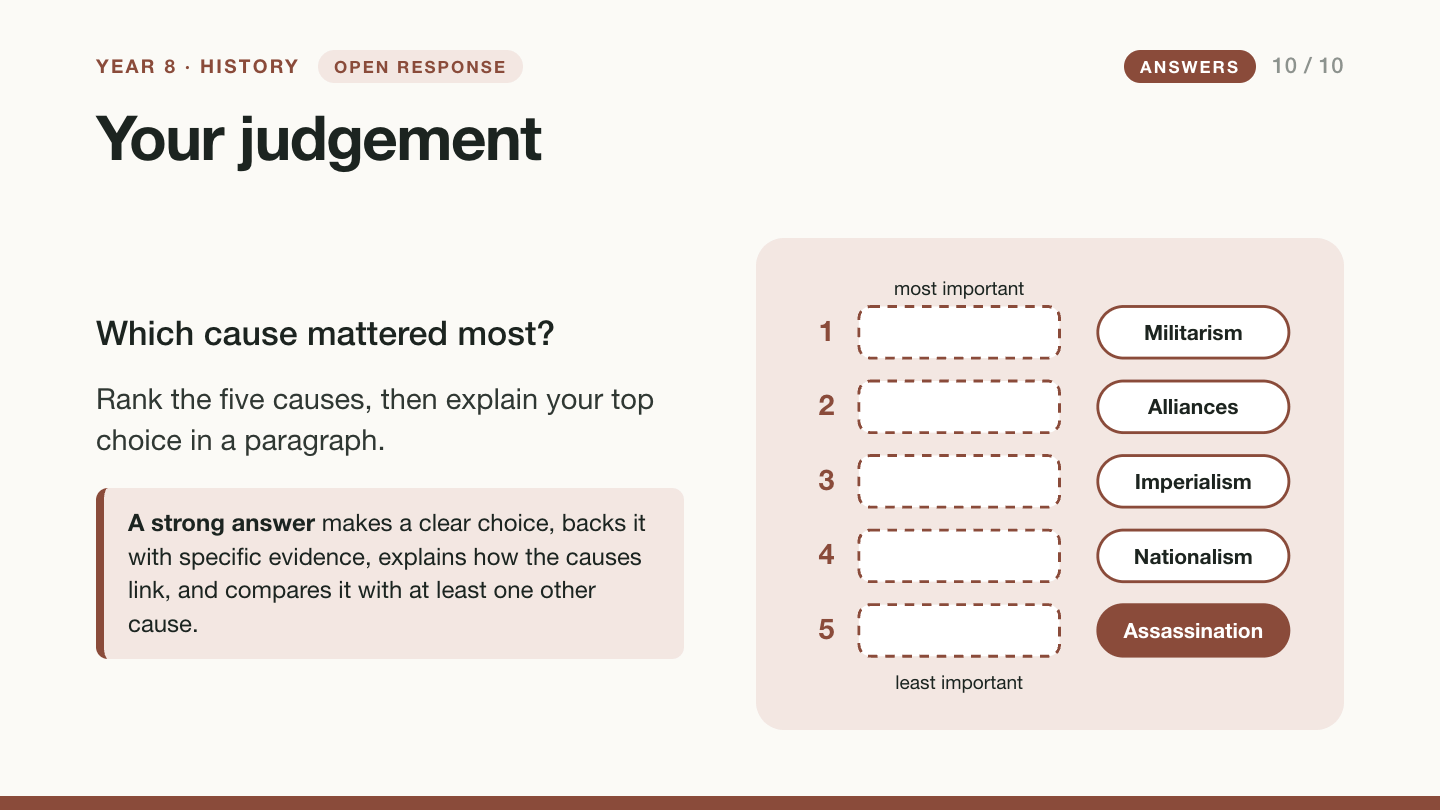
  10. Slide 10, open response: Your judgement. Which cause mattered most? Rank militarism, alliances, imperialism, nationalism and the assassination in five numbered slots from most to least important, then explain your top choice in a paragraph starting ‘The most important cause was … because …’.Slide 10 with guidance: there is no single right ranking. A strong answer makes a clear choice, backs it with specific evidence, explains how the causes link, and compares it with at least one other cause.

Worksheet

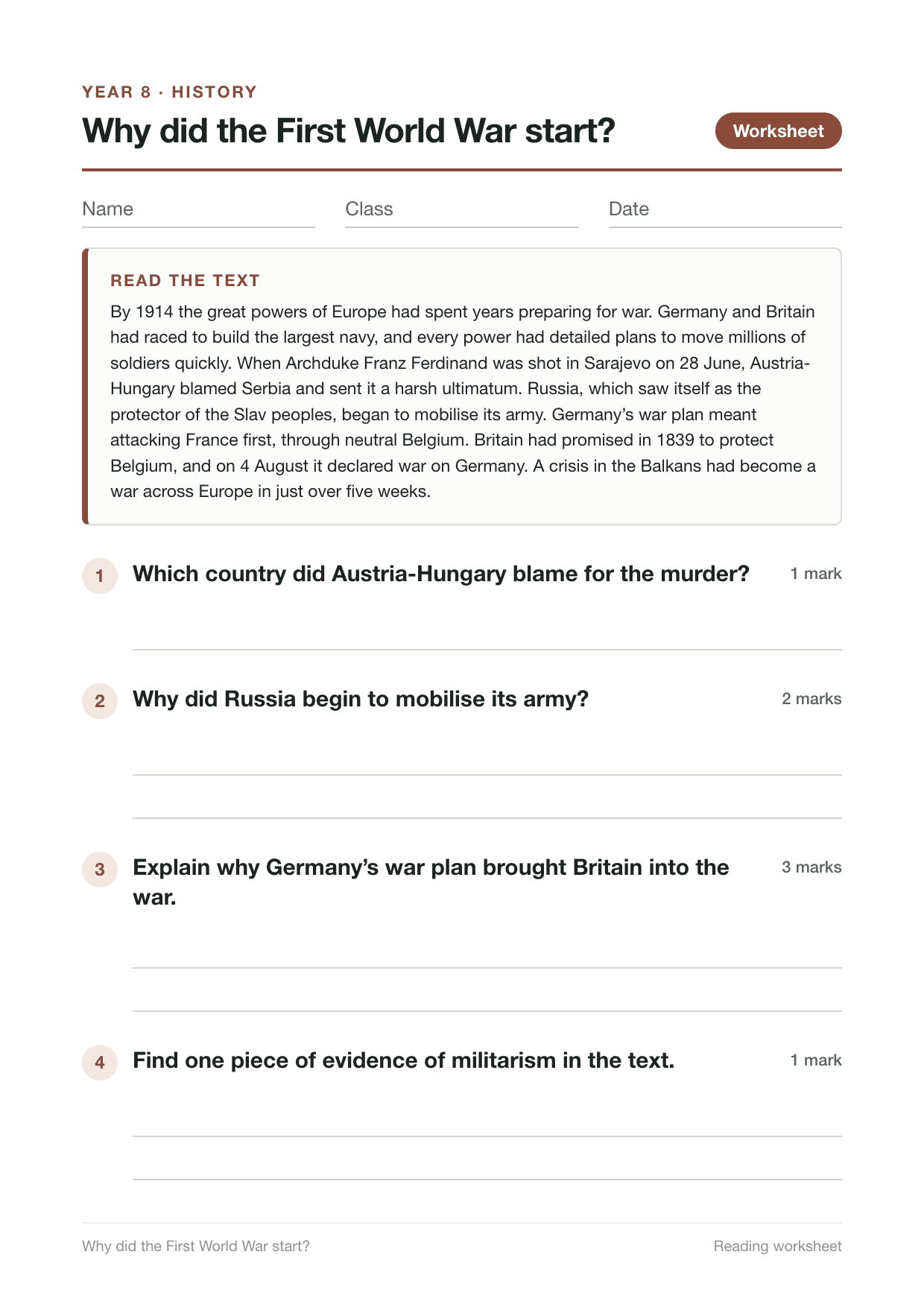
Reading worksheet for Why did the First World War start?: a short text explaining how the murder at Sarajevo, Austria-Hungary’s ultimatum, Russia’s mobilisation and Germany’s invasion of neutral Belgium led to war, followed by four questions on the text.

Mark scheme

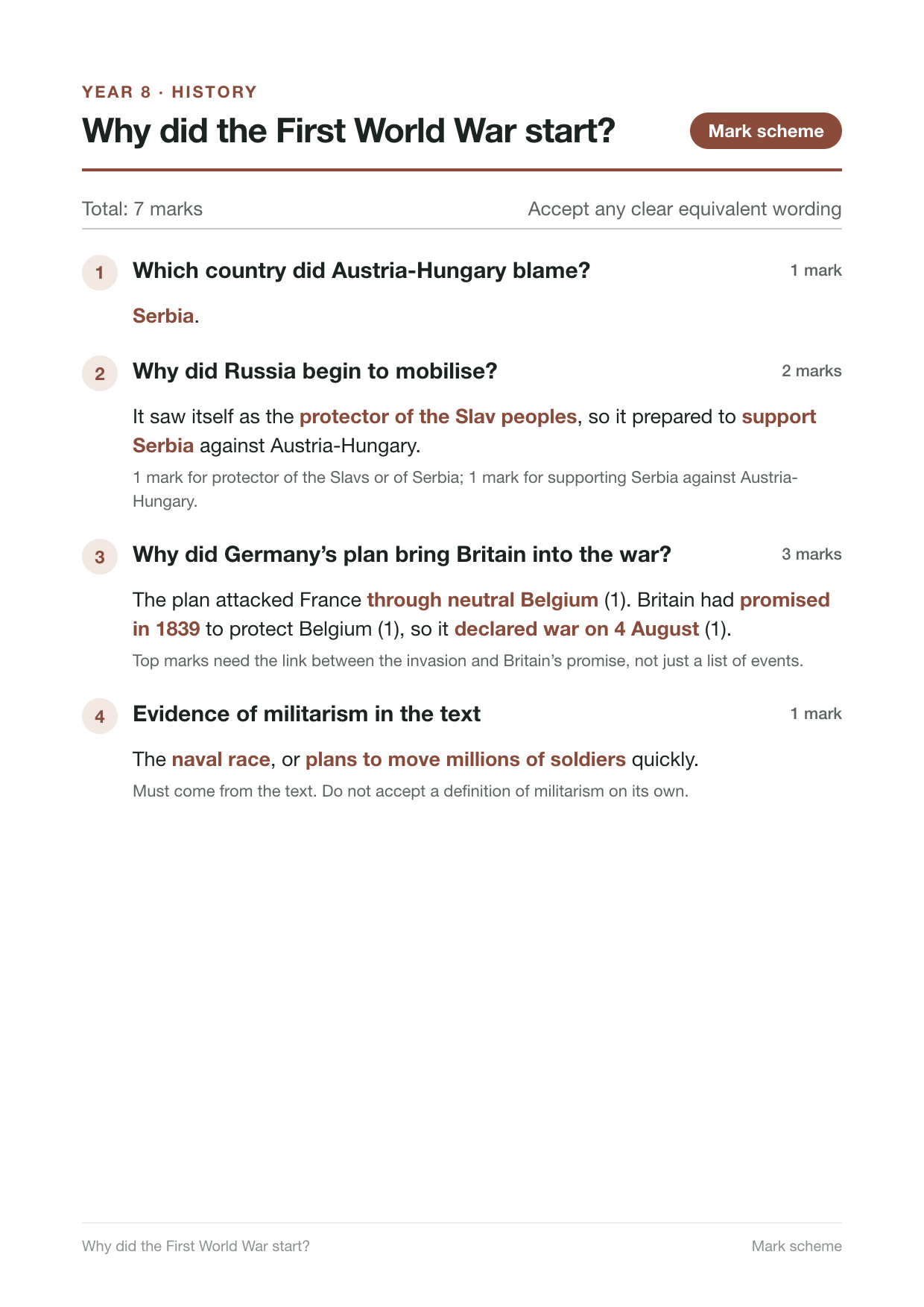
Mark scheme for the First World War reading worksheet, 7 marks: Austria-Hungary blamed Serbia; Russia mobilised as protector of the Slav peoples to support Serbia; Germany’s plan went through neutral Belgium, which Britain had promised in 1839 to protect, so Britain declared war; evidence of militarism is the naval race or plans to move millions of soldiers.

Start with the lesson
you’re teaching tomorrow.

A year group and a topic is enough.