How sound travels

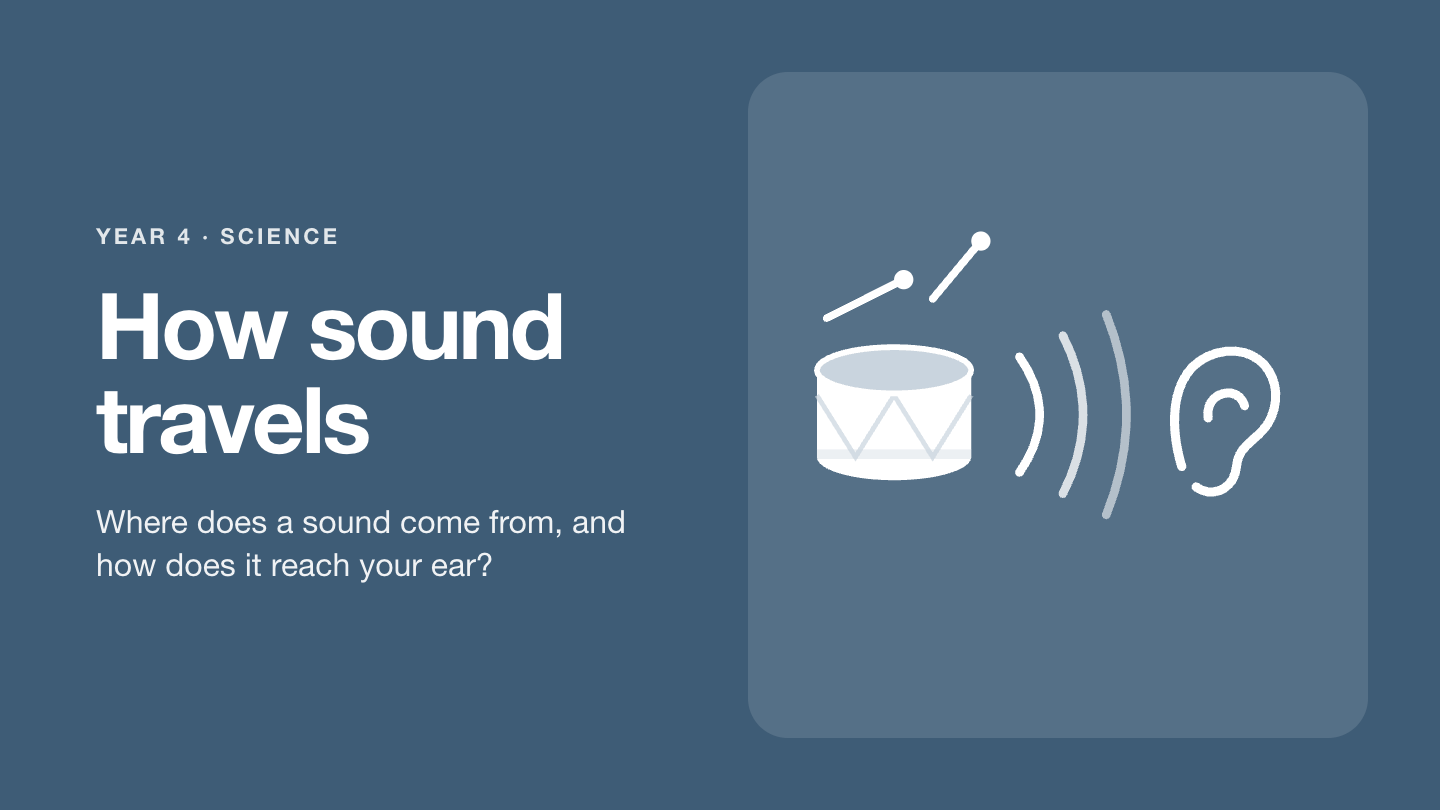
  1. Slide 1, title: How sound travels. Year 4 science. Where does a sound come from, and how does it reach your ear? A drum being hit, with curved sound lines travelling towards an ear.
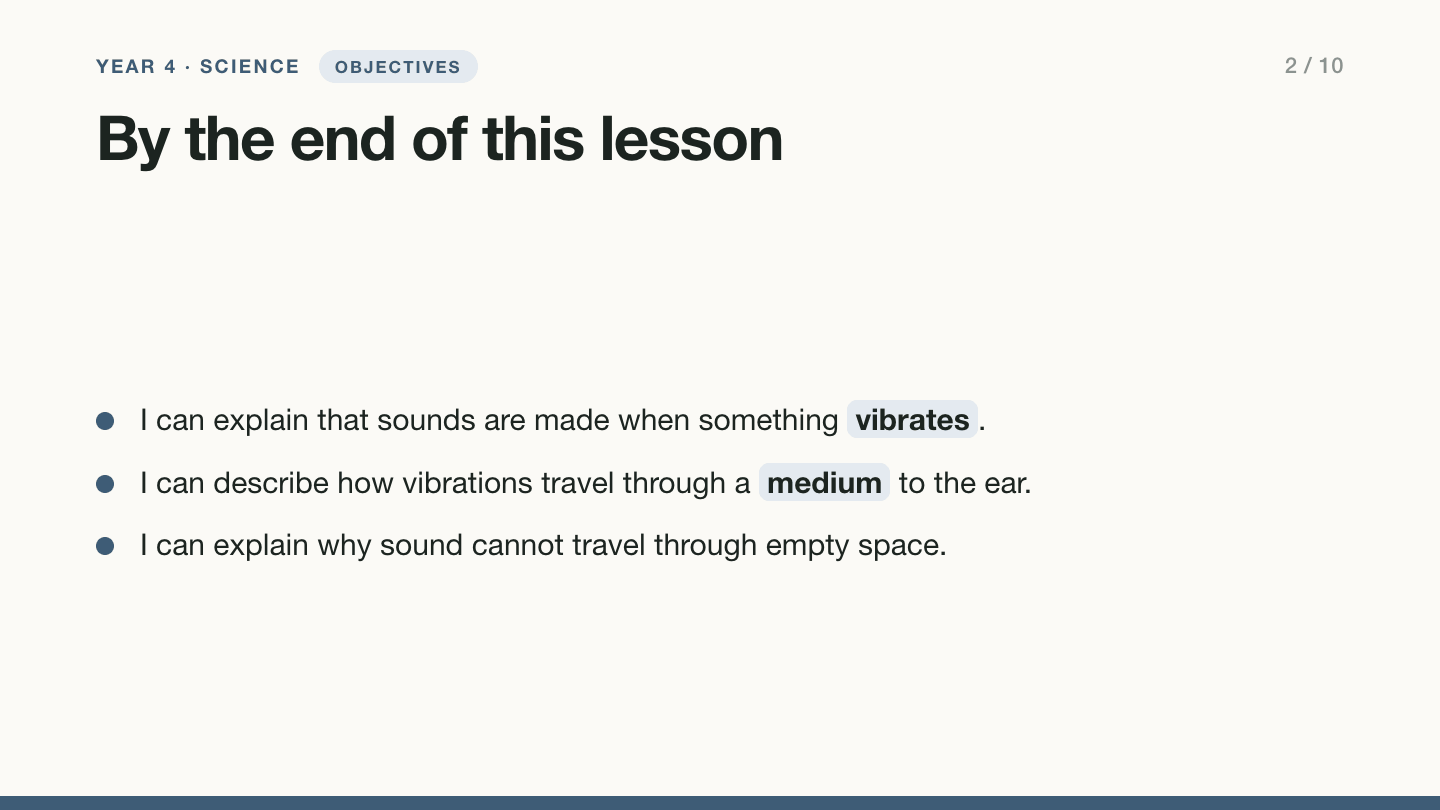
  2. Slide 2, objectives: By the end of this lesson. I can explain that sounds are made when something vibrates. I can describe how vibrations travel through a medium to the ear. I can explain why sound cannot travel through empty space.
  3. Slide 3, starter: Listen for 30 seconds. What sounds can you hear right now? What do you think is making each one? Pupils list three sounds and share with a partner. A 30 second timer.
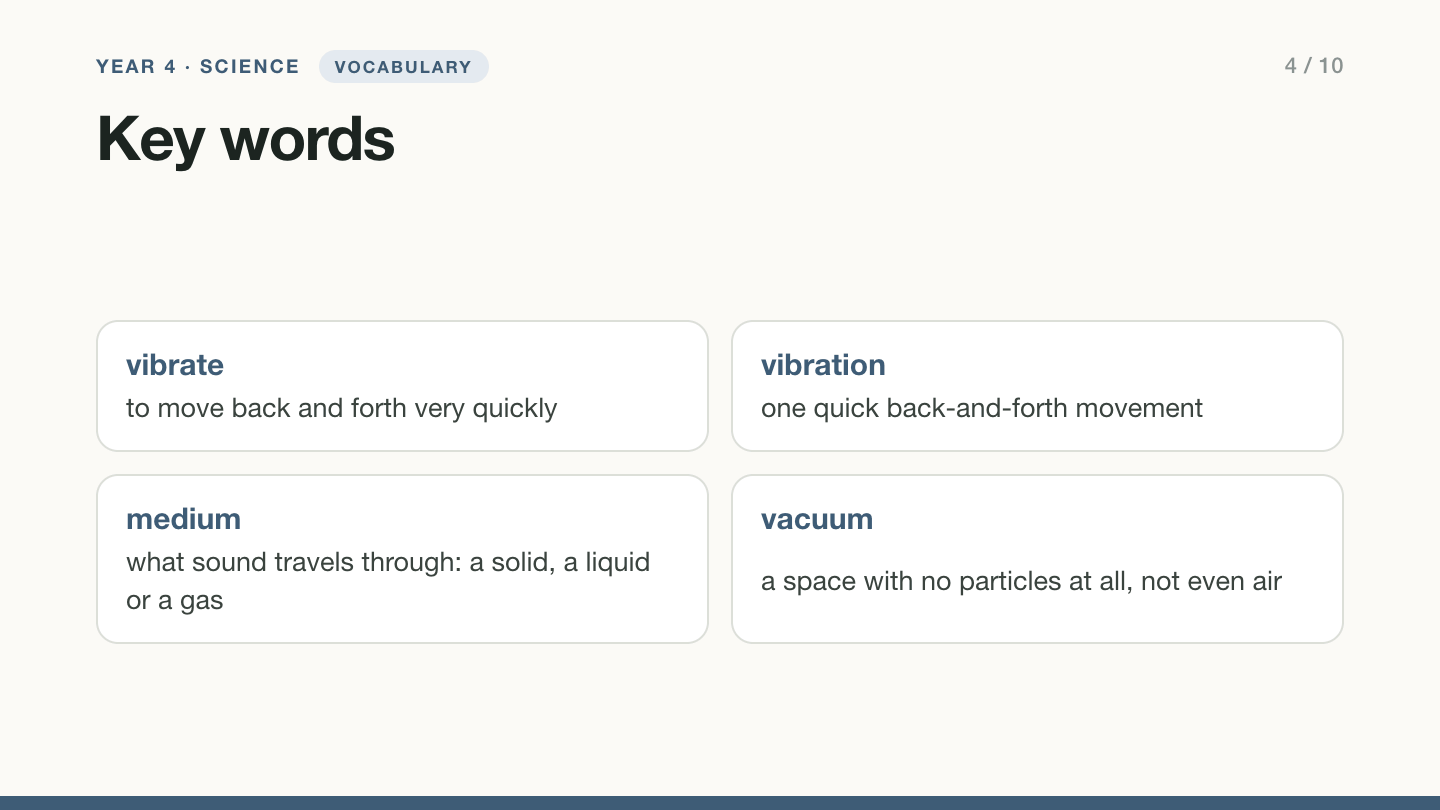
  4. Slide 4, vocabulary: Key words. Vibrate: to move back and forth very quickly. Vibration: one quick back-and-forth movement. Medium: what sound travels through, a solid, a liquid or a gas. Vacuum: a space with no particles at all, not even air.
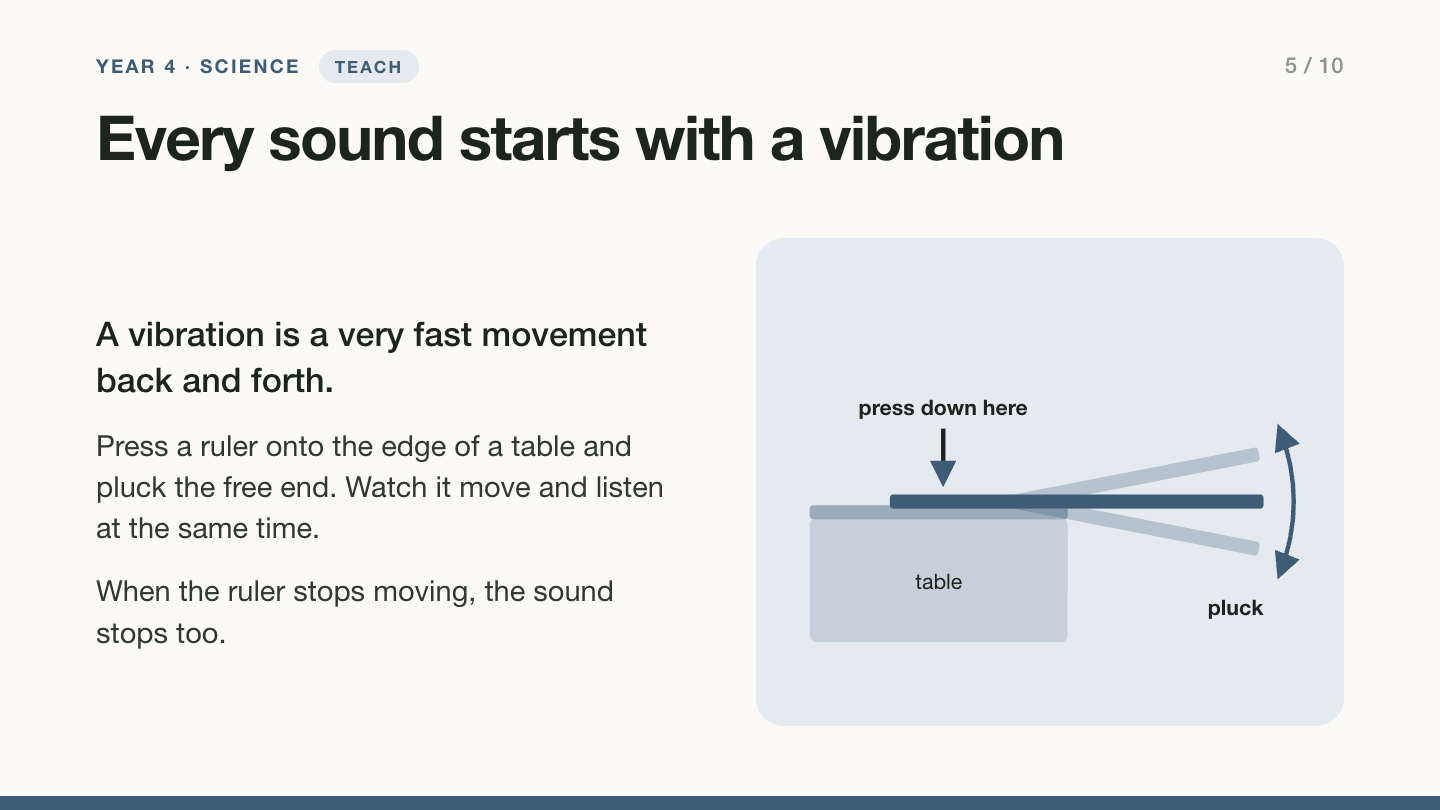
  5. Slide 5: Every sound starts with a vibration. A vibration is a very fast movement back and forth. Diagram of a ruler pressed onto the edge of a table, with the free end moving up and down after it is plucked. When the ruler stops moving, the sound stops too.
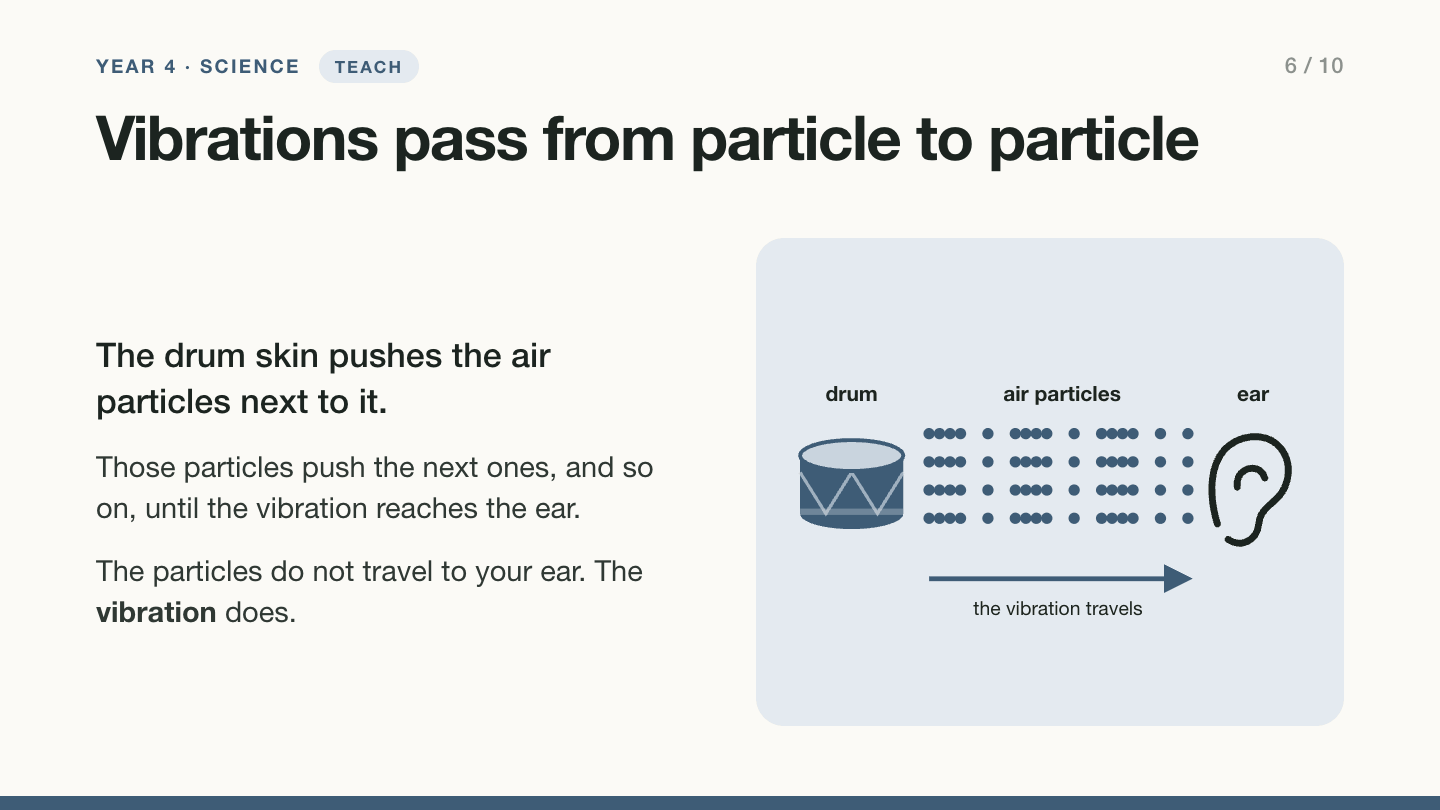
  6. Slide 6: Vibrations pass from particle to particle. A drum on the left, columns of air particles bunched together and spread apart in the middle, and an ear on the right, with an arrow showing the vibration travelling to the ear. The particles do not travel to your ear; the vibration does.
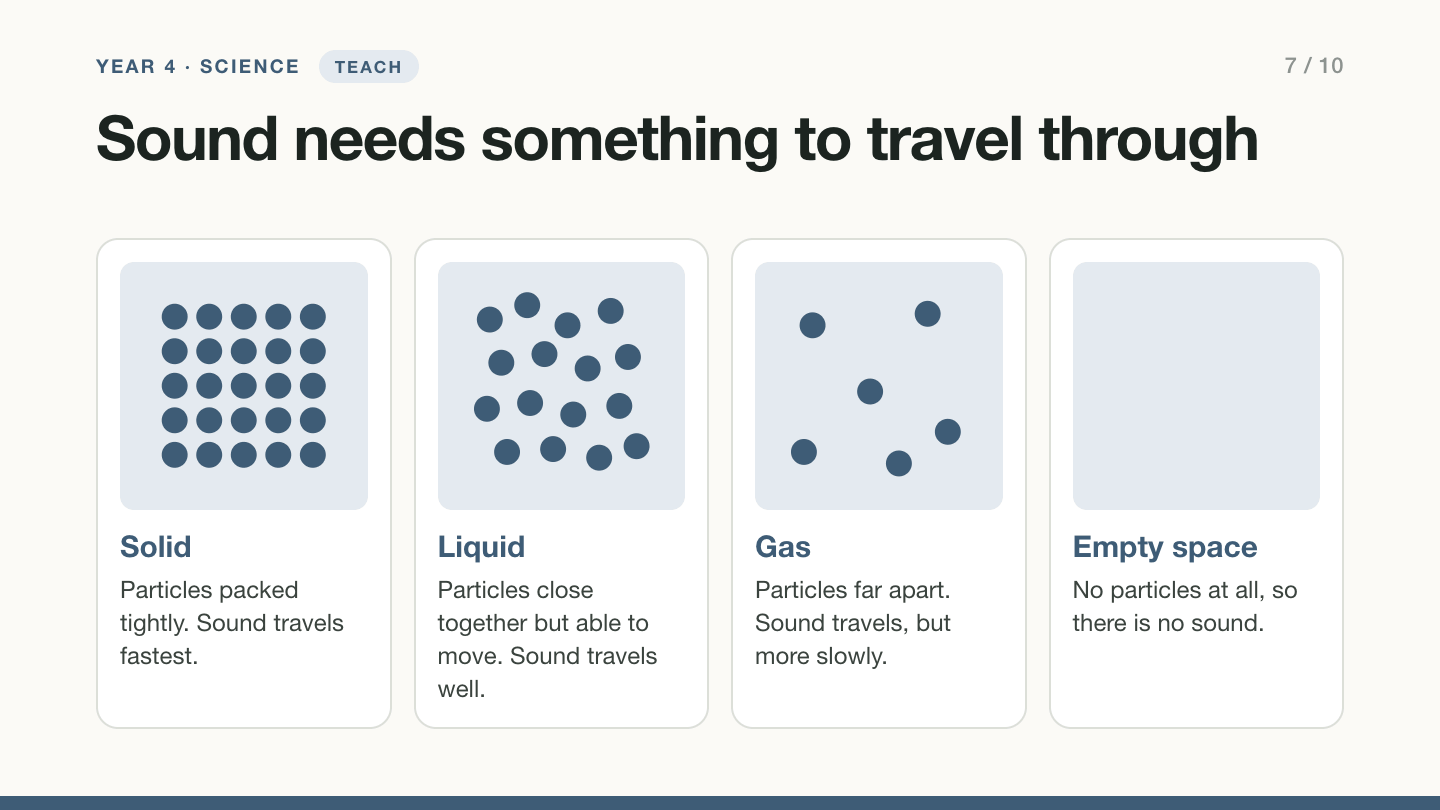
  7. Slide 7: Sound needs something to travel through. Four boxes: in a solid the particles are packed tightly and sound travels fastest; in a liquid they are close together but able to move and sound travels well; in a gas they are far apart and sound travels, but more slowly; empty space has no particles, so there is no sound.
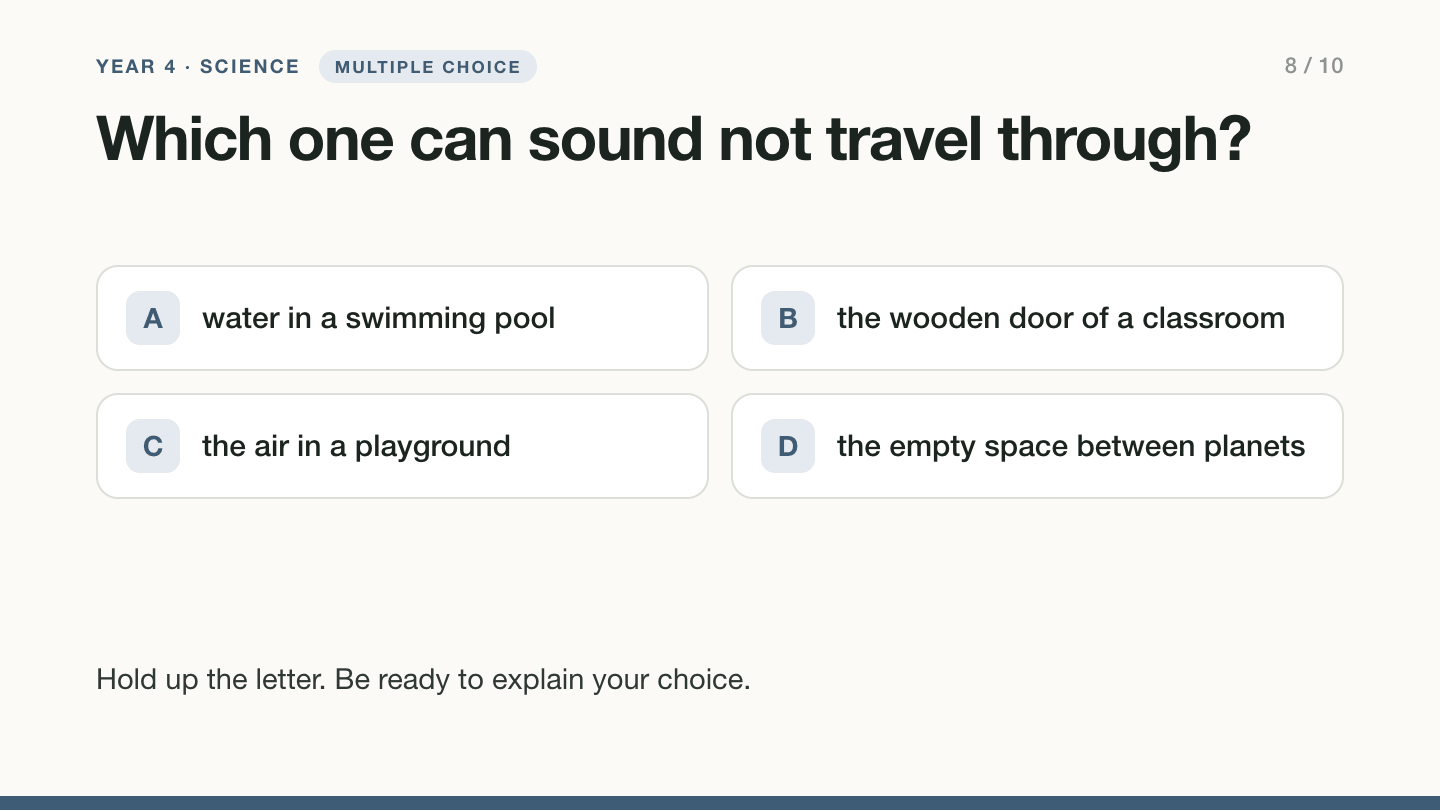
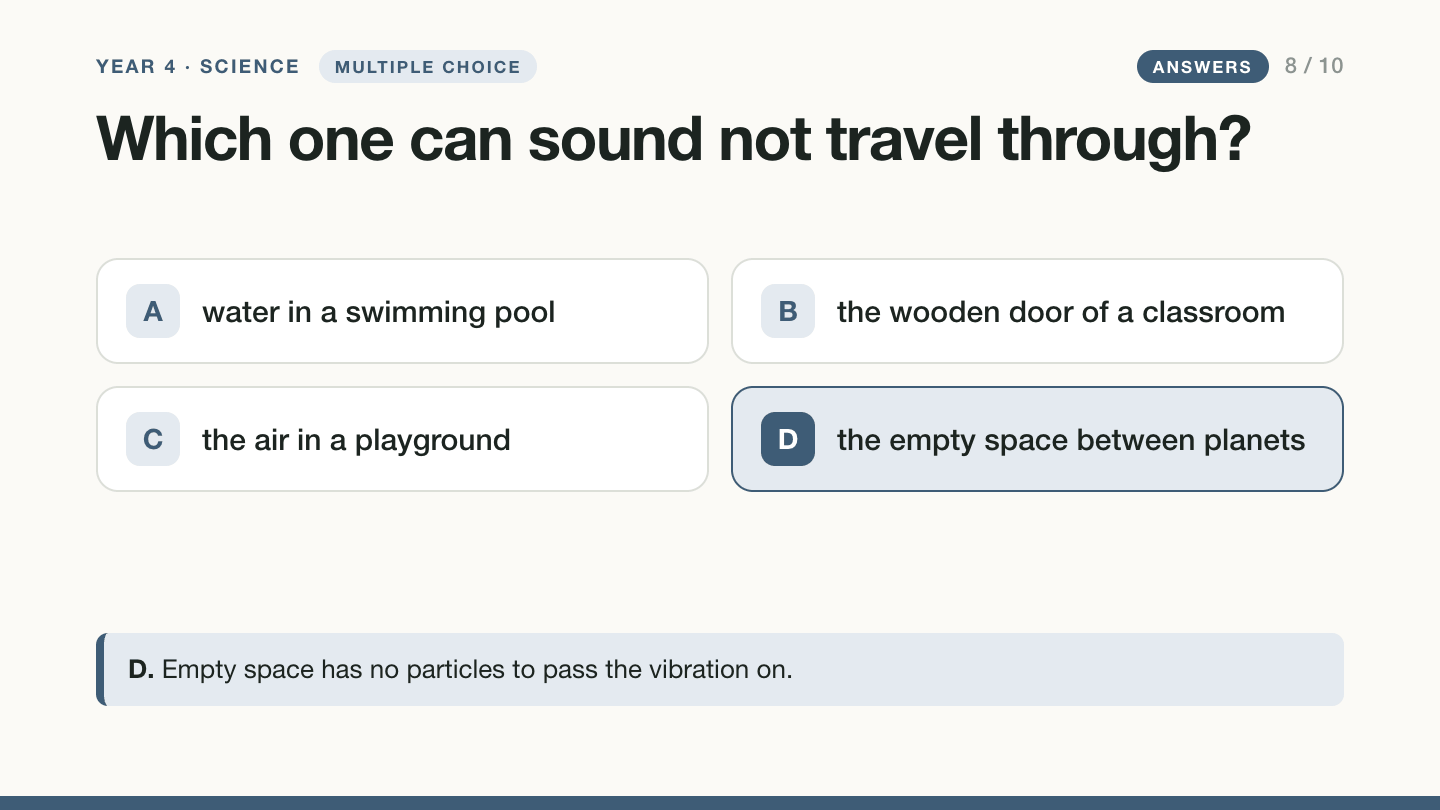
  8. Slide 8, multiple choice: Which one can sound not travel through? A, water in a swimming pool. B, the wooden door of a classroom. C, the air in a playground. D, the empty space between planets. Pupils hold up a letter and explain their choice.Slide 8 with the answer: D, the empty space between planets, because empty space has no particles to pass the vibration on.
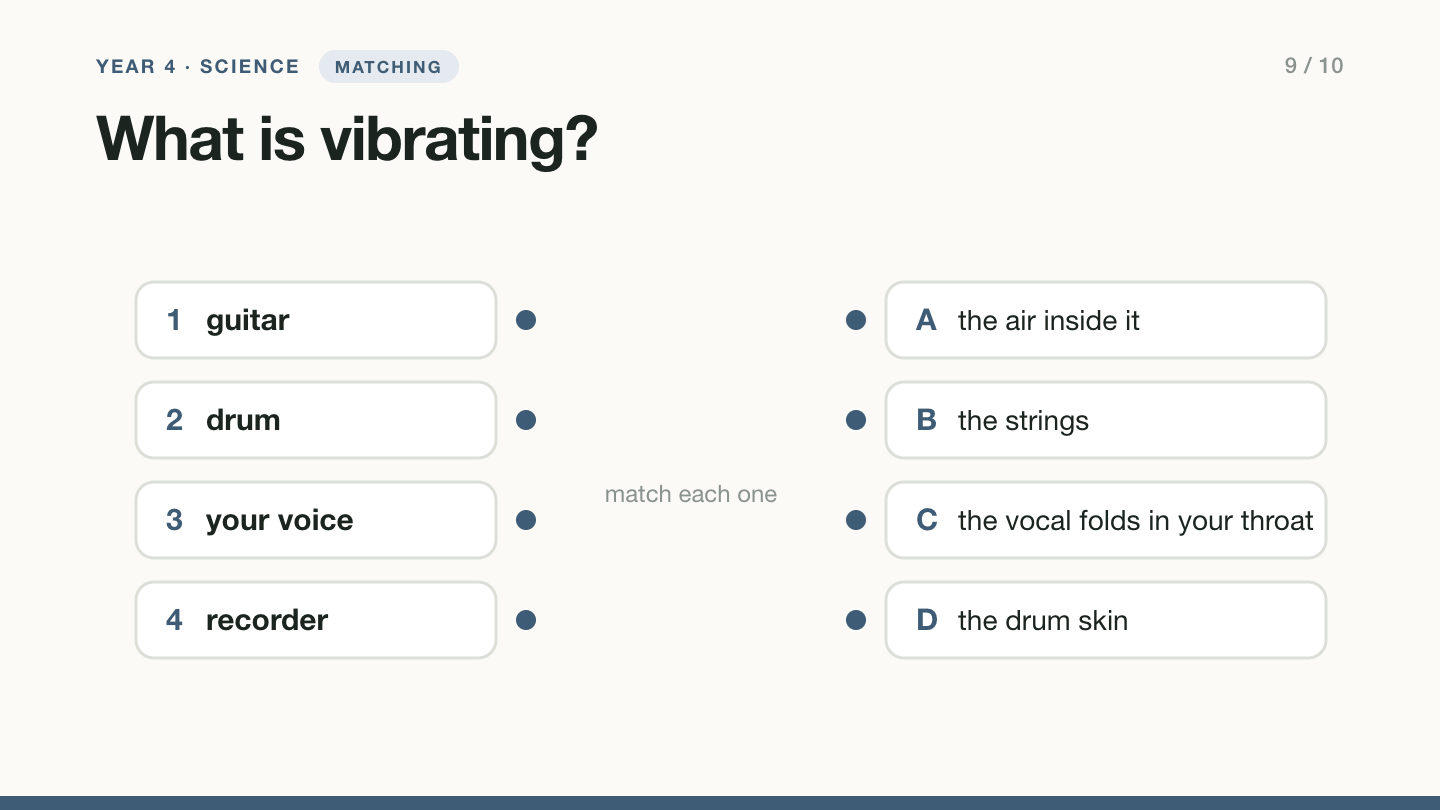
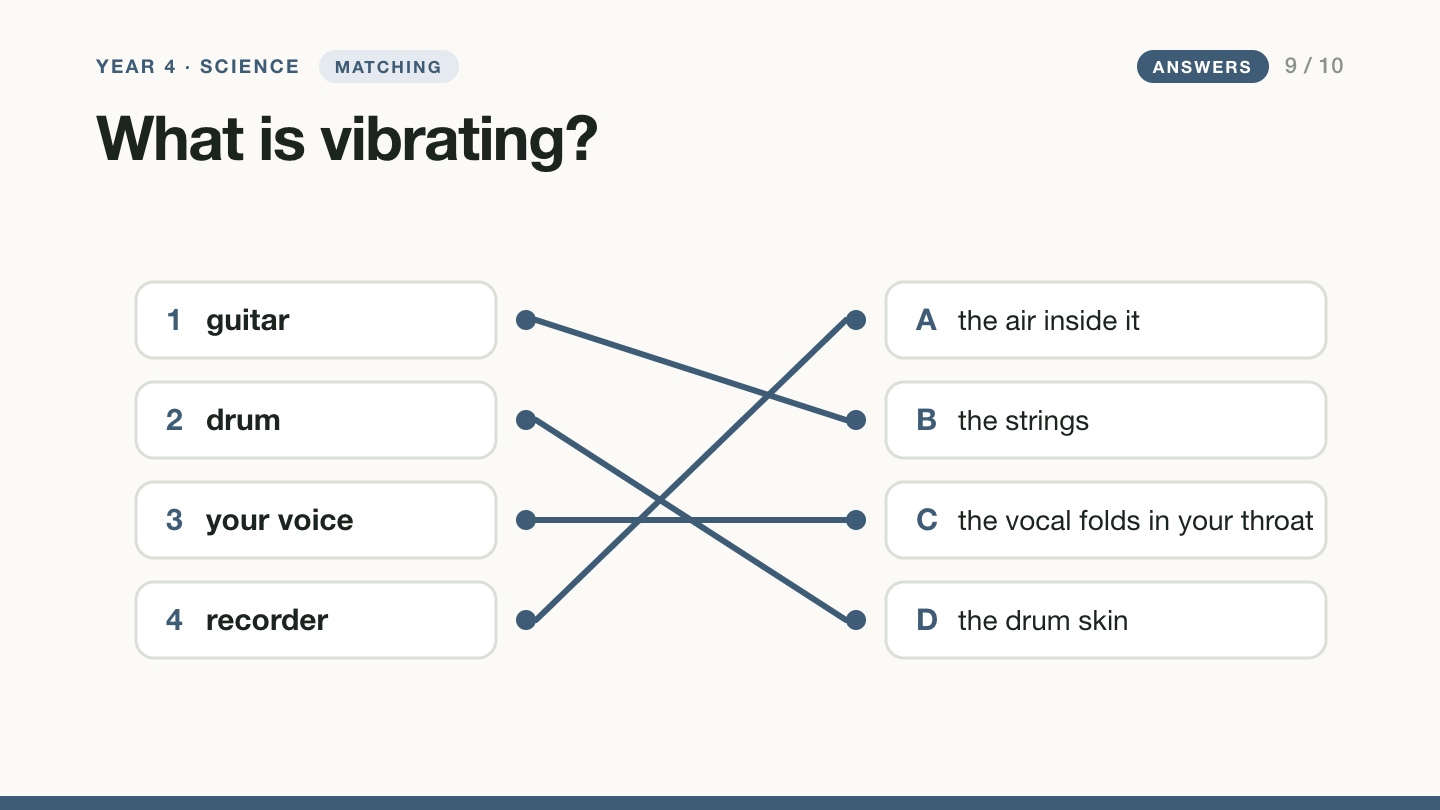
  9. Slide 9, matching: What is vibrating? Match each sound source to the part that vibrates. 1 guitar, 2 drum, 3 your voice, 4 recorder. A the air inside it, B the strings, C the vocal folds in your throat, D the drum skin.Slide 9 with answers: guitar, the strings; drum, the drum skin; your voice, the vocal folds in your throat; recorder, the air inside it.
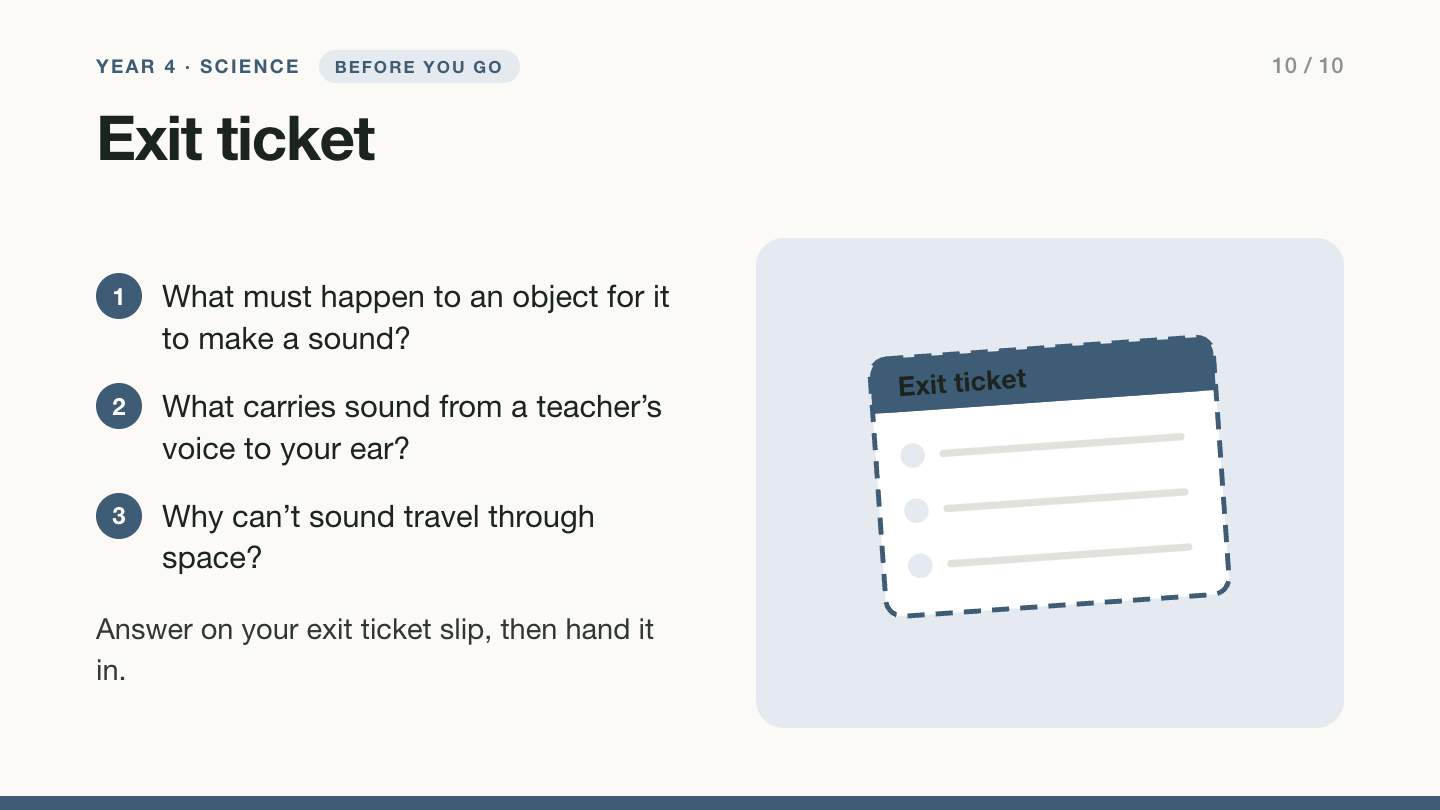
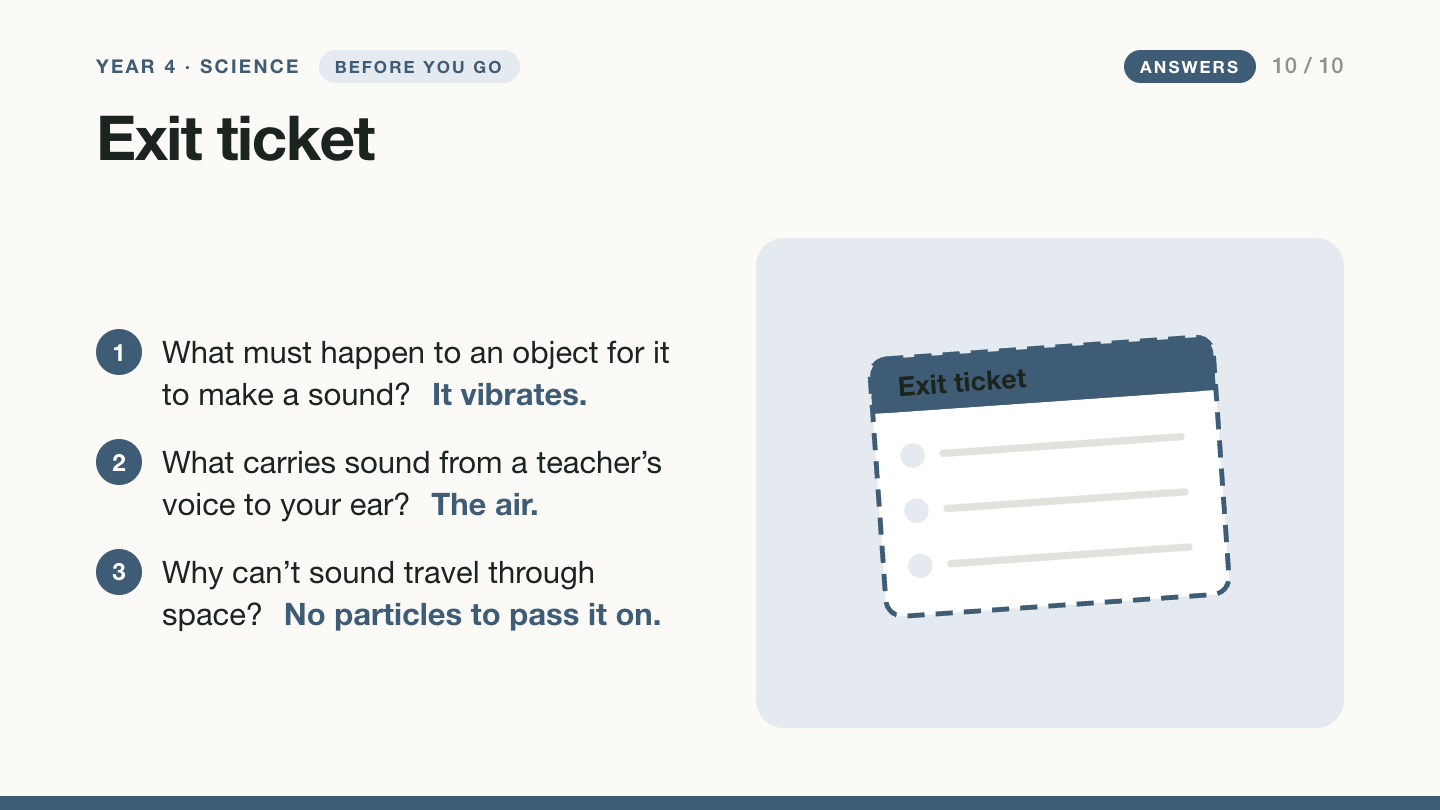
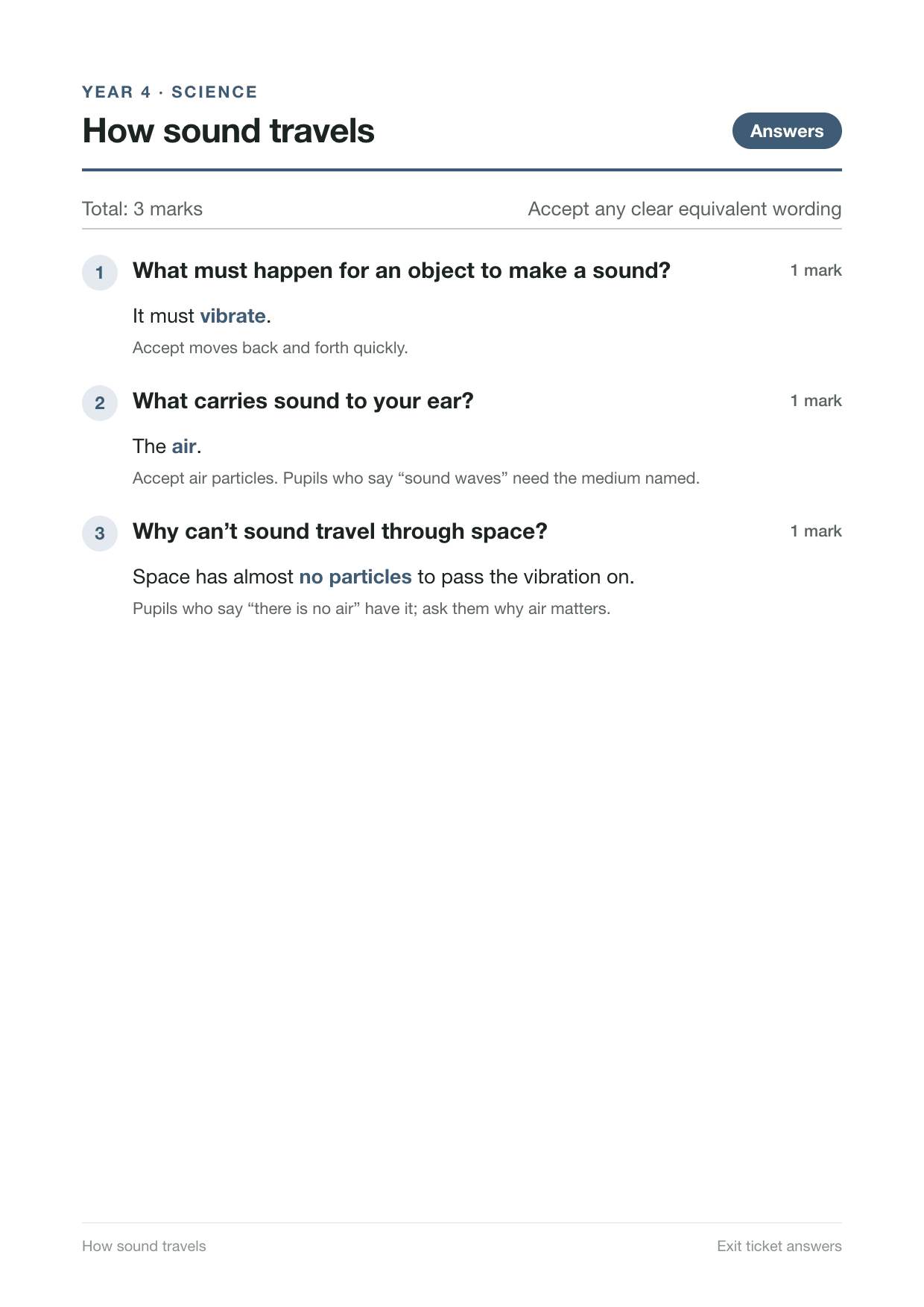
  10. Slide 10, exit ticket: answer on your exit ticket slip, then hand it in. What must happen to an object for it to make a sound? What carries sound from a teacher’s voice to your ear? Why can’t sound travel through space?Slide 10 with answers: the object vibrates; the air carries the sound; space has no particles to pass the vibration on.

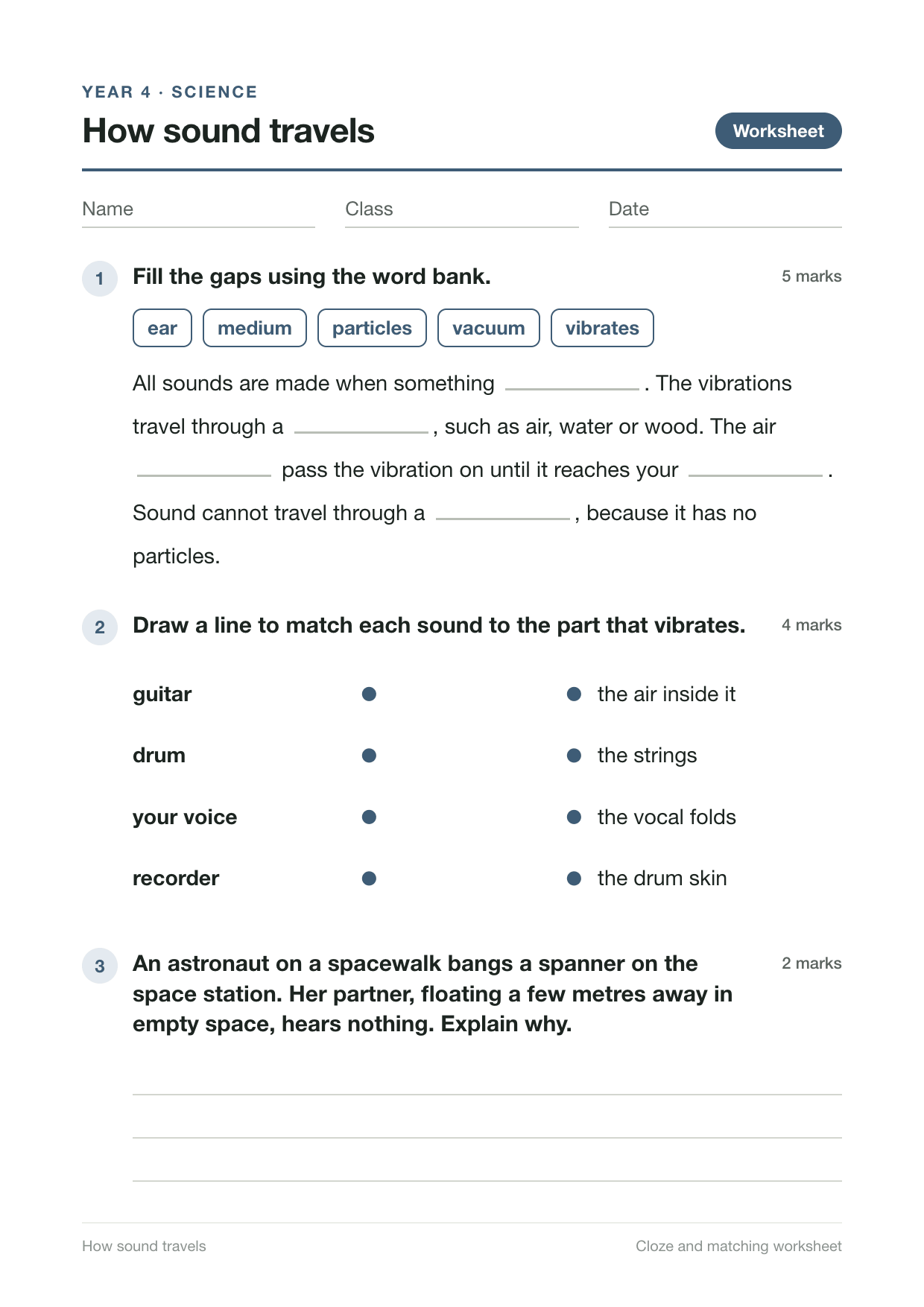
Worksheet

Cloze and matching worksheet for How sound travels: fill five gaps in a paragraph about sound using the word bank ear, medium, particles, vacuum and vibrates; draw lines matching a guitar, drum, voice and recorder to the part that vibrates; and explain why an astronaut cannot hear a spanner banged in empty space.

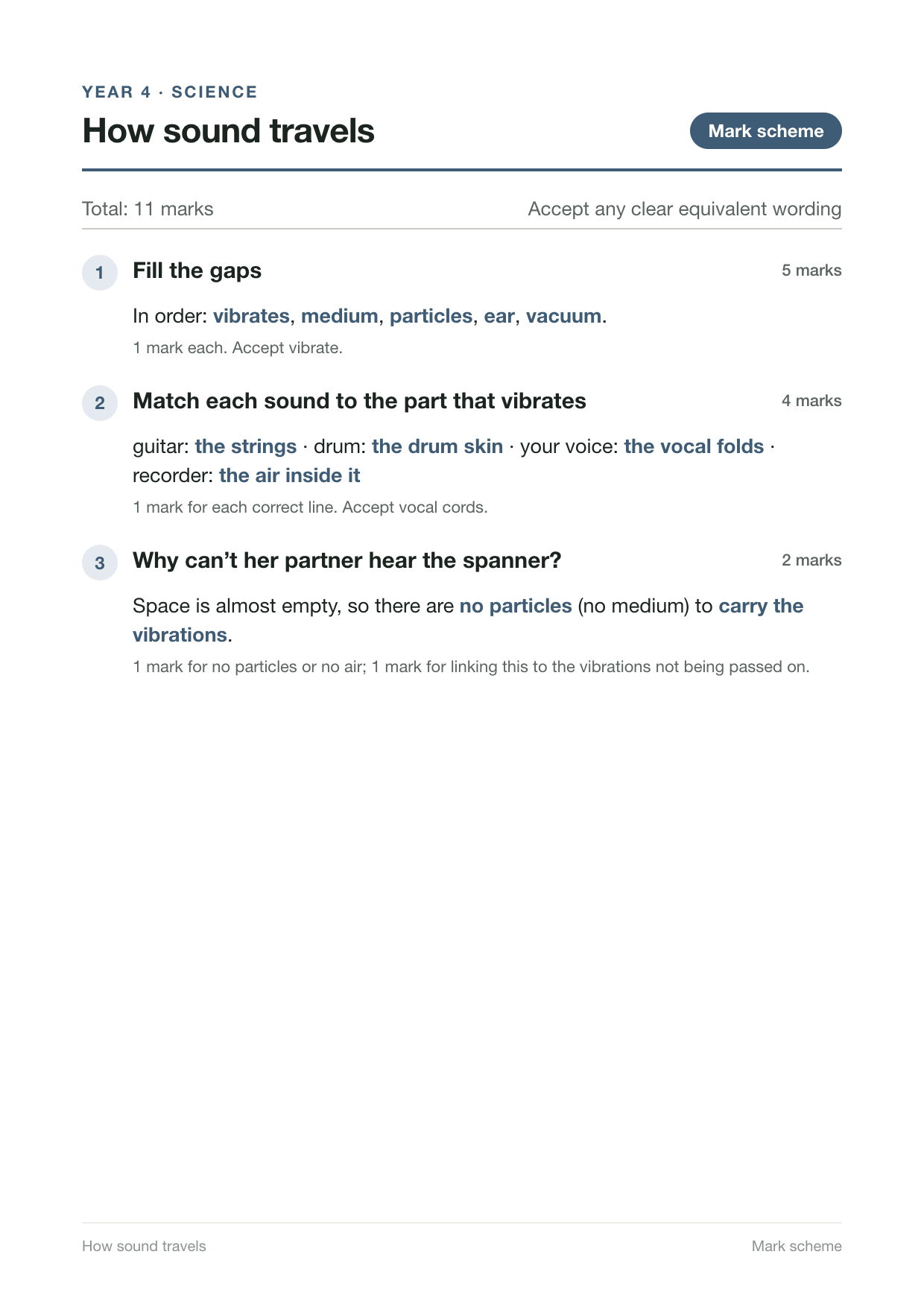
Mark scheme

Mark scheme for the How sound travels worksheet, 11 marks: the gaps are vibrates, medium, particles, ear and vacuum; guitar matches the strings, drum the drum skin, voice the vocal folds and recorder the air inside it; space has no particles to carry the vibrations, with a mark for each idea.

Exit ticket

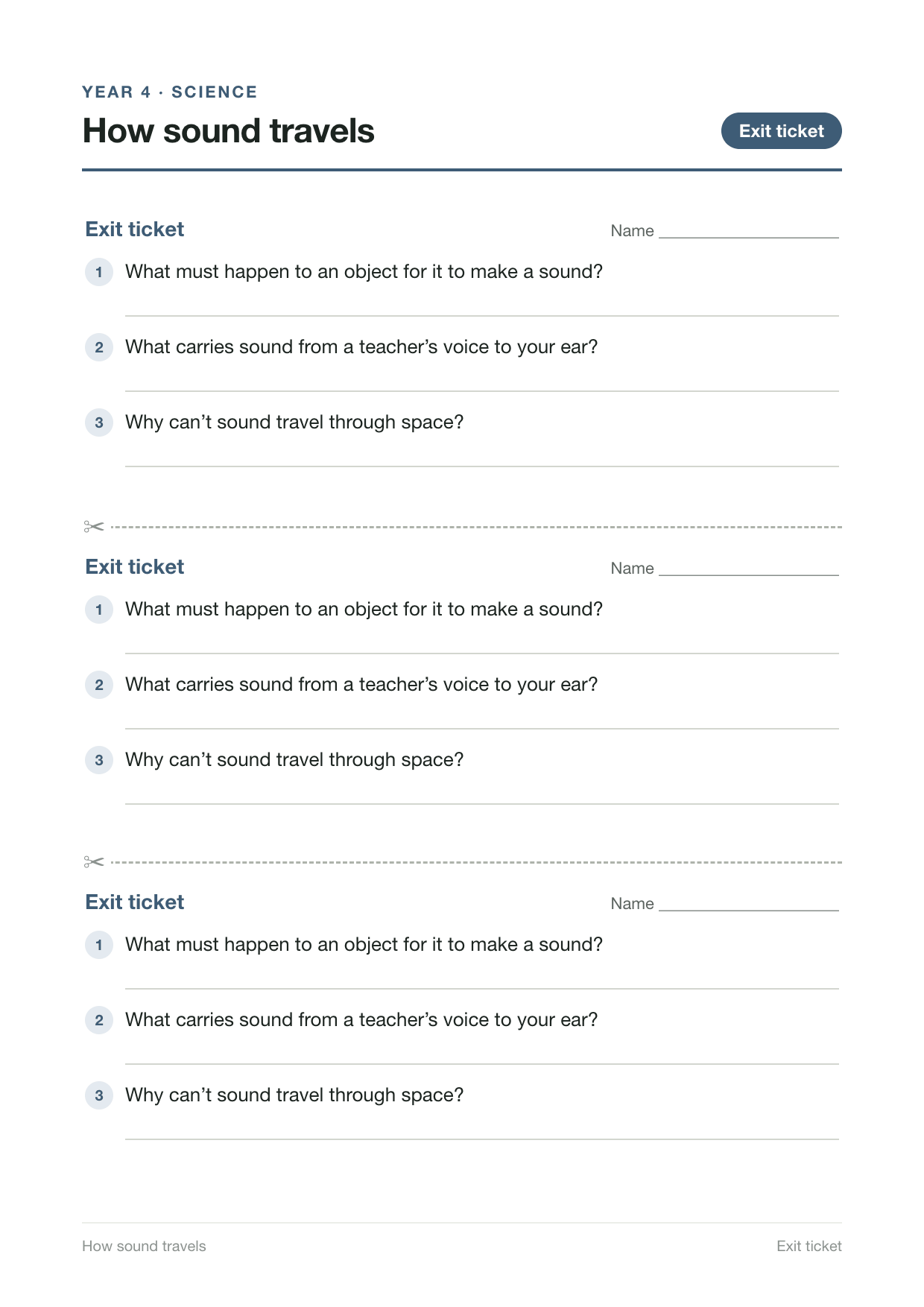
Exit ticket slips for How sound travels, three to a page to cut out: what must happen to an object for it to make a sound; what carries sound from a teacher’s voice to your ear; why can’t sound travel through space.

Answers

Exit ticket answers for How sound travels: the object must vibrate; the air carries the sound; space has almost no particles to pass the vibration on, with notes on common part answers.

Start with the lesson
you’re teaching tomorrow.

A year group and a topic is enough.